
360 STRATEGIC INTELLIGENCE BRIEF
Trump-Xi Beijing Summit
May 14-15, 2026
Managed Symbolism, Structural Accommodation, and What Was Left Unresolved
Geopolitical Intelligence | Decision Signal System
Executive Summary
The first U.S. presidential state visit to China in nearly a decade concluded with managed symbolism and incremental agreements. This was not a grand bargain. The summit produced one primary structural outcome: codification of a bilateral framework described as constructive, strategic, and stable. It extends the fragile trade truce established at the Busan Summit in October 2025 and signals continuity through the end of Trump's term in January 2029.
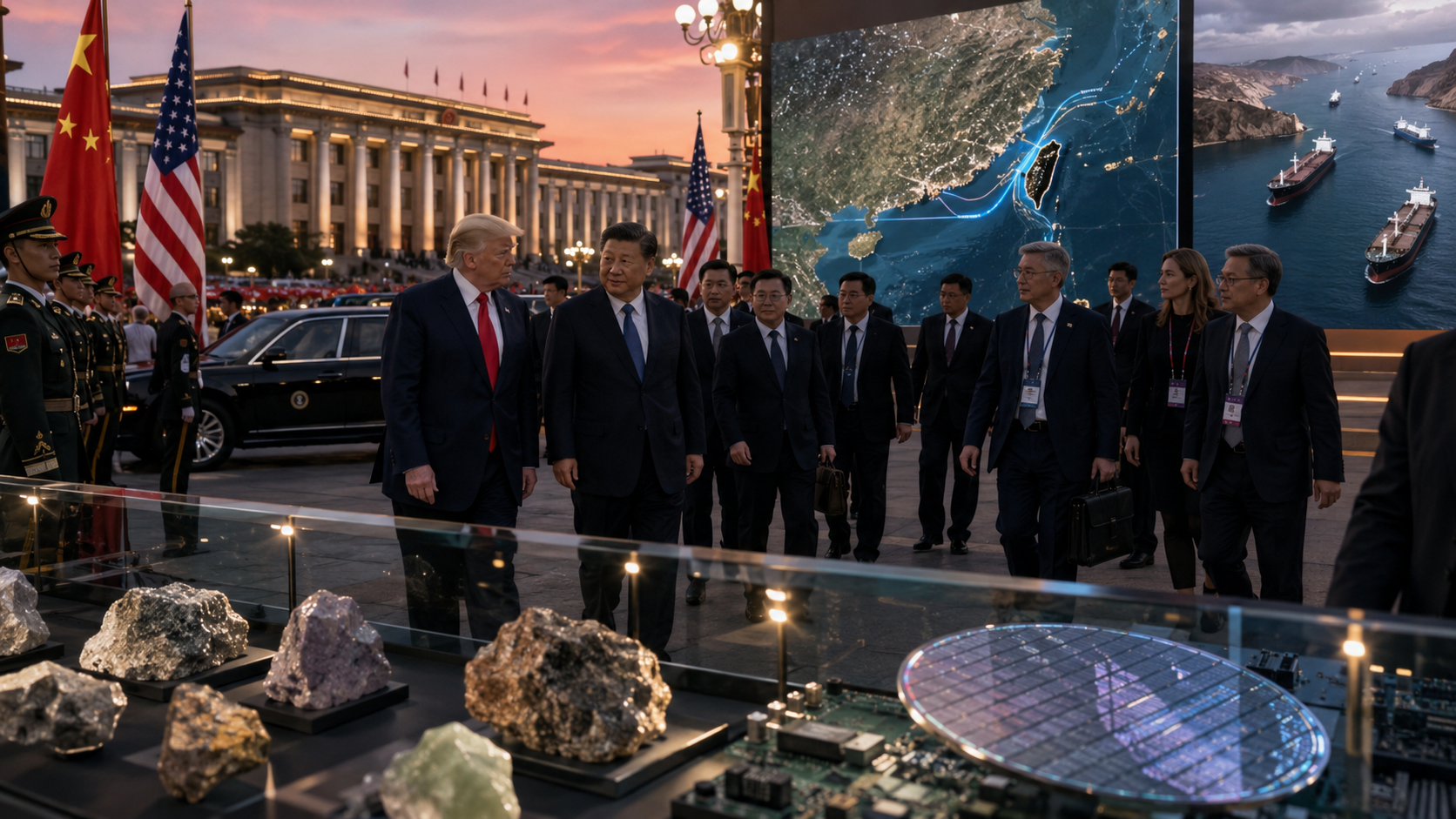
Both leaders got what they needed from the optics. Xi demonstrated sovereign authority on home turf, reinforced Taiwan as a non-negotiable red line, and received a 17-CEO delegation as visible evidence of China's continued economic magnetism. Trump returned with warm imagery, trade concessions he can sell to midterm voters, and enough stability to avoid domestic economic deterioration.
The headline deliverables were modest. The deeper structural tensions, including Taiwan, AI chips, rare earth weaponization, nuclear escalation, and the Iran war, were managed rather than resolved.
This brief focuses on what was actually agreed, what the subtext reveals, what the Decision Signal System indicators say about client exposure, and the questions the headline coverage is not asking.
What Actually Happened
Ceremony and Delegation Composition
Trump arrived in Beijing on May 13. Vice President Han Zheng received him with military honors, national anthems, and hundreds of children waving flags. Bilateral talks were held in the Great Hall of the People on May 14 at 10 AM local time and lasted approximately two hours, double the originally scheduled duration.
The delegation composition was itself a signal. Trump brought 17 CEOs, including Elon Musk and Jensen Huang, directly on Air Force One. Xi met the executives and told them China's door would only open wider. Premier Li Qiang separately met with Musk, Cook, and Huang. The message was explicit: China remains open for business on Beijing's terms.
This structure served both leaders. Trump demonstrated that American corporate capital is still invested in China. Xi advertised that global capital continues to choose China. The CEOs were not neutral observers. They were the evidence.
Confirmed Outcomes
The summit produced a defined but limited set of agreements.
| Area | What Was Agreed | Signal |
|---|---|---|
| Trade Truce | Extension of the October 2025 Busan agreement. Mutual tariff framework maintained. | Tariff rate of ~47% on Chinese goods holds. New escalation avoided. |
| Strait of Hormuz | Both leaders agreed that the Strait must remain open to global energy flows. | Xi expressed interest in Chinese purchases of U.S. oil. Aspiration only, not operational resolution. |
| Agriculture | China renewed U.S. beef processing plant export licenses. Soybean purchase signals reported at 25 million metric tons per year for three years. | Confirmed deliverable for Trump’s rural voter base. |
| Fentanyl | Both sides committed to continued stemming of precursor chemical flows. | Continuation of Busan commitment. No new mechanism. |
| Board of Trade | Framework under development to manage non-sensitive sector purchases. Requires domestic approval in both countries. | Designed to institutionalize trade management. Still conceptual. |
| Strategic Stability | Both leaders agreed to a ‘constructive, strategic, and stable’ bilateral orientation through Trump’s term. | Xi set a three-year horizon. Locks in the current power balance. |
| Xi Washington Visit | Trump invited Xi to Washington on September 24, 2026. | Reciprocal summit formally placed on the calendar. |
| Boeing Aircraft | Deal not formally announced. Negotiations ongoing. | Contingent on broader agreement. 500-jet order in play. |
| Rare Earths | No new agreement. Existing truce holds. | Export licensing bottlenecks continue in defense and advanced tech sectors. |
| AI and Semiconductors | No agreement reached. AI-enabled warfare is discussed. | Semiconductor deal blocked by the national security wing. Dynamic set for APEC. |
| Taiwan | No formal policy shift. Xi delivered an explicit warning. Trump declined to confirm that Taiwan was discussed. | Status quo fragile. Arms package in de facto limbo. |
Reading Between the Lines
1. Xi Controlled the Narrative and the Venue
Xi's opening remarks were a structured exercise in strategic communication. He invoked the Thucydides Trap, framed China as a rising power deserving partnership not containment, congratulated the U.S. on its 250th anniversary, and then issued an unmistakable warning on Taiwan. All in the opening remarks. The sequencing was deliberate.
Establish philosophical equality. Offer an economic partnership. Set a hard condition. By invoking clashes and even conflicts over Taiwan before the first working session, Xi set the diplomatic temperature for the entire visit without making Taiwan the formal centerpiece.
Trump responded with characteristic flattery. You're a great leader. Sometimes, people don't like me saying it, but I say it anyway. Xi received this with composed silence. On Chinese social media, the exchange generated mockery. For the Chinese Communist Party and the Chinese public, it served a different purpose. It demonstrated that the United States came to Beijing to pay respect.
Signal: Xi has internalized that Trump's transactional instincts are manageable through flattery and visible economic inducements. The partner, not rival, language is a strategic deployment. It establishes a precedent that any future American hardening on trade, Taiwan, or technology will be characterized as a betrayal of bilateral relations rather than legitimate competition.
2. The Iran War Gave Xi the Upper Hand
Trump arrived in Beijing having failed to bring the Iran conflict to a close to his satisfaction. The Strait of Hormuz remains functionally compromised. Trump had hoped to leverage Xi's influence over Tehran. Instead, he was forced to publicly state that the U.S. does not need any help with Iran. Simultaneously, Secretary Rubio pressed China to take a more active role in resolving the conflict. These two positions cannot both be true.
China is the world's largest oil importer. Roughly 30% of its oil passes through the Strait of Hormuz. A prolonged conflict is genuinely damaging to Chinese economic interests. Yet Beijing holds leverage here. China provided high-level assurances before the summit that it would not send weapons to Iran. That cleared the path for the meeting. It did not constitute pressure on Tehran to reopen the Strait.
Signal: China's role in Iran is a strategic card, not a genuine deliverable. Beijing is willing to refrain from arming Iran in exchange for U.S. concessions on Taiwan and chips. It is not willing to resolve the conflict. Xi expressed interest in buying more U.S. oil to reduce dependence on the Gulf. That is a bilateral economic play. The Strait reopening remains tied to Iran-U.S. negotiations, not to this relationship. Iran will remain a pressure point through the APEC Shenzhen in November.
3. Taiwan: The Concession That May Have Already Been Made
The most alarming subtext of this summit is what did not happen on Taiwan.
Before the visit, Trump explicitly stated he would discuss arms sales with Xi. That statement alone broke with the Six Assurances, the foundational 1982 Reagan-era commitments establishing that the U.S. would not consult China on arms sales to Taiwan. When reporters asked post-meeting whether Taiwan was discussed, Trump declined to answer.
The $14 billion arms package remains in limbo, neither approved nor formally abandoned. The $11 billion December 2024 package was approved, but delivery has not proceeded. The Trump administration halted weapons shipments ahead of the summit and has not resumed them.
Xi's formulation at the summit was the strongest public language he has used in a joint forum with a U.S. president: Taiwan independence is fundamentally incompatible with peace in the Taiwan Strait. The Taiwanese government issued a statement of gratitude for U.S. support without confirming any new commitments. The caution in that language is notable.
Signal: The most important Taiwan outcome may be what was not said publicly. The $14 billion package is almost certainly being delayed indefinitely. The $11 billion package faces delivery uncertainty. If Trump tacitly agreed not to proceed, even informally, Beijing will treat that as a precedent-setting concession and leverage it in future negotiations. For Taipei, this is a material deterioration of credible deterrence, even if no formal policy language changed.
4. The CEO Delegation as Economic Leverage Theater
The 17-CEO delegation served a dual purpose. For Trump, it demonstrated that American business remains invested in China. For Xi, it was a tool for reassuring U.S. corporate capital that China remains a viable market, neutralizing business-community advocacy for harder-line policies.
The specific composition is analytically significant. Jensen Huang in AI chips. Tim Cook in manufacturing and supply chain. Kelly Ortberg of Boeing in commercial aviation. Larry Fink in global capital flows. Elon Musk with Tesla's largest overseas market. Fintech executives from Mastercard, Visa, and Citi. These were not companies seeking new opportunities. They were companies with existing exposure to China that Beijing can selectively squeeze if the relationship deteriorates.
Xi's message to them was direct: your operations in China are safe as long as the relationship is stable. The unspoken corollary was equally clear.
Signal: American corporate capital is now a structural tool in Chinese foreign policy. These companies' China dependencies create a domestic U.S. lobbying constituency against Taiwan defense, chip restrictions, and aggressive trade policy. Beijing has cultivated this dynamic deliberately over decades. It is now operational.
5. Rare Earths: The Leverage Remains in Place
Heavy rare earth exports from China, specifically yttrium, dysprosium, and terbium, remain roughly 50% below pre-restriction levels despite the October 2025 truce. China's export licensing process continues to selectively throttle supply to defense and advanced technology sectors. The truce suspended the framework for new restrictions. It did not undo the operational reality of restricted supply.
China controls approximately 85% to 90% of global rare-earth processing and virtually all heavy-rare-earth separation. The U.S. remains over 70% import-dependent on China for these materials. A 10% disruption in rare earth-dependent sectors could trigger an estimated $150B in global losses within a year. U.S. diversification efforts through Project Vault and international partnerships remain years from meaningful supply independence.
Signal: The rare earth truce is a managed ceasefire, not a structural resolution. China's continued selective licensing in defense-critical sectors means that U.S. defense production and advanced manufacturing face a supply vulnerability that persists regardless of the summit's language. The truce expiration, potentially as early as November 2026, is now a hard operational planning deadline.
6. AI and Semiconductors: Internal U.S. Division Played in Public
The AI and semiconductor dynamics within the U.S. delegation were themselves a visible source of tension. Trump's inclusion of Jensen Huang on Air Force One, reportedly not in the original invitation, signaled openness to discussing chip access. Rubio simultaneously told reporters that any semiconductor agreement would face fierce resistance from the national security wing. This divergence was not incidental.
China has been deliberately refusing to import Nvidia H200 chips, which Trump had permitted under conditions, preferring to hold out for access to the more powerful H20 and H100-class architecture. The calculation is explicit: Chinese AI firms would accept H200s today, but Beijing is holding out to force a precedent-setting concession on advanced architecture that would accelerate China's AI development timeline.
Signal: No semiconductor deal was reached at this summit, but the dynamic is set for one. The implicit trade is chip access in exchange for normalization of rare-earth exports. Trump views this as a trade issue. Rubio views it as a national security issue. This internal split will be Beijing's primary negotiating surface through year-end. Expect a structured deal to emerge at APEC Shenzhen in November 2026 if geopolitics permit.
The Thucydides Trap Signal
Xi's invocation of the Thucydides Trap in opening remarks was the most strategically dense element of the summit. This was not a philosophical observation. It was a positioning statement.
The message: China is the rising power. You know it. We know it. History says this ends in war unless you accommodate the rise. By framing this as a shared challenge, can we avoid it together, Xi positioned any future U.S. hardline policy as the cause of potential conflict rather than a legitimate deterrent. It is a preemptive narrative capture of the escalation ladder.
This framing also directly challenges the architecture of U.S. policy since the Obama Pivot to Asia. The argument that U.S. presence, alliances, and deterrence are stabilizing rather than destabilizing is contested by Xi's framework. He is offering an alternative: great-power stability through bilateral agreement between the two principals, with alliances, international law, and rules-based order architecture sidelined.
If conflict ever comes, Xi has already established a rhetorical baseline that the United States failed to choose stability.
Strategic Power Assessment
Who Held the High Ground
China's structural position entering this summit was strong across all dimensions.
- Beijing survived Trump's 145% tariff escalation without capitulating.
- It weaponized rare earths as a strategic tool and demonstrated willingness to use them. When Xi threatened restrictions in April and October 2025, Trump changed course within hours.
- The Iran war depleted U.S. missile stockpiles, degraded Trump's domestic approval to roughly 30% on economic management, and handed Xi a diplomatic card.
- U.S. courts invalidated key IEEPA tariff tools, weakening unilateral leverage.
- Beijing positioned Taiwan as the price of stability, forcing Trump to choose between Taiwan's security and trade concessions.
The U.S. position of vulnerability was equally clear.
- Over 80% reliance on China for rare earths powering military and industrial applications.
- A $200B+ goods trade deficit with China despite sustained tariff pressure.
- Midterm elections in November 2026 creating pressure for visible economic wins.
- Iran war costs rising alongside inflation near 4% and potential Federal Reserve tightening.
- Boeing is dependent on Chinese orders for financial recovery. Apple's manufacturing is deeply embedded in China.
The 2026 summit was, in structural terms, a continuation of the leverage dynamic established in October 2025. China has now internalized that its rare earth card and energy positioning are sufficient to manage Trump transactionally. That capability will define Chinese strategy regardless of who occupies the White House from 2029 onward.
Decision Signal System Indicators
The following DSS indicators are activated or elevated following the Beijing summit. These reflect the operational intelligence posture Ridgeline recommends for clients across affected sectors.
Tier 1: High Alert
DSS-SUPPLY [RAREEARTH-CRITICAL]
Bottlenecks in China's rare-earth export licensing remain operational despite the truce. Heavy rare-earth exports are 50% below pre-restriction levels in the defense and advanced-tech sectors. Companies with rare earth-dependent manufacturing, including defense contractors, EV manufacturers, semiconductor fabs, wind energy, and aerospace, face sustained supply volatility.
Decision Implication: Audit rare earth exposure across supply chains now. Any organization in defense manufacturing, advanced electronics, or clean energy with China-sourced rare earths should be stress-testing alternative suppliers and stockpiling strategies before Q3 2026. The expiration of the November 2026 truce is a hard operational deadline.
DSS-TRADE [TRUCE-EXPIRY-CLOCK]
The Busan trade truce was extended, but core structural tariffs remain in place at approximately 47% on Chinese imports. The truce's most consequential elements, rare earth controls and reciprocal tariff suspensions, expire in November 2026, precisely when the U.S. midterm election cycle peaks. The Board of Trade mechanism remains conceptual. There is no durable institutional channel for conflict resolution.
Decision Implication: Plan for renewed trade volatility in Q4 2026. Any organization with China-dependent supply chains should model a scenario where tariffs revert to pre-truce levels by November 15, 2026.
DSS-TAIWAN [STRATEGIC AMBIGUITY EROSION]
The $14B Taiwan arms package is in de facto limbo. Trump publicly acknowledged discussing arms sales with Xi, breaking the Six Assurances protocol. The $11B December package has no delivery timeline. Xi issued an explicit warning of a clash and conflict, with no formal U.S. pushback. Strategic ambiguity, the foundational concept governing U.S.-Taiwan relations, is becoming strategically vacant.
Decision Implication: Any organization with Taiwan supply chain exposure, including semiconductor manufacturing, advanced electronics, and shipping through the Taiwan Strait, must run enhanced force-majeure and supply-disruption scenarios. The risk window for a Taiwan miscalculation narrows as clarity of U.S. commitment decays.
Tier 2: Elevated Monitoring
DSS-ENERGY [HORMUZ-DISRUPTION]
The Strait of Hormuz remains functionally compromised from the Iran conflict. Both Trump and Xi agreed it must remain open. That is aspiration, not operational reality. China holds mixed incentives on this issue. It is structurally motivated to resolve the disruption, given that over 30% of its oil imports transit the Strait. Its geopolitical interest in a prolonged U.S.-Iran standoff complicates that motivation.
Decision Implication: Clients in energy, commodities, shipping, and industrial manufacturing with Gulf exposure continue to face supply and pricing volatility. Oil price upside risk persists into H2 2026.
DSS-AI/TECH [EXPORT CONTROL FLUX]
The AI chip policy dynamic is in active flux. Trump's inclusion of Huang on Air Force One signals openness to a chip deal. Rubio's resistance signals an unresolved internal split. The implicit trade, chip access for rare earth normalization, is structurally logical but politically difficult in a midterm year. No announcement was made. The groundwork was laid.
Decision Implication: Organizations in semiconductor design, AI infrastructure, and advanced computing should monitor closely. An H200 or H20-class access agreement with China, if reached at APEC, would materially alter Nvidia's China revenue and competitive positioning for Chinese AI firms. Defense-sector clients should assume restricted chip architecture remains in place through year-end.
DSS-GEOPOLITICAL [COALITION FRAGMENTATION]
Xi's strategic stability framework, with its implicit offer to manage the relationship bilaterally rather than through alliances, poses a structural risk to U.S. alliance architecture. Japan, South Korea, Taiwan, Australia, and the Philippines are watching to see whether U.S.-China bilateral stabilization comes at the expense of trilateral security commitments. Russia's attack on Kyiv during the summit, which the Ukrainian foreign minister directly linked to the Beijing meeting, was a signal that adversaries interpret U.S.-China engagement as a reduction in Western solidarity.
Decision Implication: Organizations with Asia-Pacific operational footprints or ally-market exposure should elevate geopolitical monitoring. If U.S. alliances in the Indo-Pacific are perceived as weakened, Chinese assertiveness in the South China Sea accelerates, regional security calculus shifts, and market risk premiums across ASEAN reprice.
DSS-CORPORATE [CHINA ACCESS NORMALIZATION]
Xi's message to U.S. CEOs was explicit: China's door will only open wider. For organizations in financial services, consumer technology, and clean energy, this signals near-term improvement in regulatory and market access conditions in China. That access carries a structural dependency risk. China now treats U.S. corporate presence as a lever in bilateral negotiations.
Decision Implication: Treat the current access window as a conditional opportunity, not a structural shift. China is offering access as a stabilizing tool and can withdraw it selectively if the relationship deteriorates.
Tier 3: Watch List
DSS-NUCLEAR [STRATEGIC STABILITY GAPS]
New START expired in February 2026, leaving the U.S. and Russia without binding nuclear limits for the first time since the 1970s. China is expanding its nuclear arsenal. AI is entering targeting and decision-support systems. Neither a U.S.-China pre-launch notification agreement nor a no-first-use framework was announced at this summit. Xi's strategic stability framework may be the entry point for conversations on nuclear risk reduction. None materialized.
Decision Implication: Not an immediate operational indicator for most clients, but relevant for defense, risk consulting, and sovereign advisory practices. The absence of nuclear risk reduction channels creates elevated systemic risk that will be priced into defense and insurance markets.
DSS-IRAN [ENDGAME UNCERTAINTY]
As of this summit, the U.S. and Iran remain at war. China did not commit to pressuring Tehran. A 14-point memo on conflict-resolution parameters is being developed by Pakistani mediators. China's role is limited to restraint, not resolution. The Iran endgame is not in Chinese hands, but Beijing controls the normalization timeline by deciding how much diplomatic pressure it applies.
Decision Implication: Oil prices and Hormuz-dependent shipping remain volatile. No client should model a Hormuz reopening before Q3 2026 at the earliest.
Questions the Headlines Are Not Asking
Seven signal gaps deserve executive attention.
1. Why did the summit run two hours when one was scheduled? Extended-duration signals either deeper progress or more difficult disagreement than is publicly acknowledged, particularly on Taiwan. Two hours of unscheduled time does not reflect routine agenda management.
2. Why did Trump decline to confirm whether Taiwan was discussed? That specific non-answer on a specific question is unusual. It strongly implies that discussions on Taiwan occurred that neither side wants to characterize publicly.
3. What did Eric and Lara Trump discuss in China in a personal capacity? The Trump Organization's presence during a state visit, through family members who manage Trump's personal finances, represents an unprecedented potential conflict of interest that has received almost no press scrutiny.
4. Why did China invoke its blocking statute framework three days before the summit? MOFCOM Announcement No. 21, issued May 2, 2026, prohibiting Chinese companies from complying with U.S. oil sanctions on Chinese petrochemical companies, was not an administrative routine. It established a new legal tool deployable against U.S. extraterritorial sanctions and created negotiating leverage before Trump landed. The timing was deliberate.
5. What is the Board of Trade actually designed to do? The mechanism is framed as conflict reduction. It could also serve as a Chinese veto point on future U.S. tariff increases if trade decisions are institutionalized through a bilateral board requiring approval from both countries' domestic authorities. That structurally embeds China's approval in U.S. trade policy architecture.
6. Did the summit accelerate or decelerate Taiwan's timeline? Xi's warning about clashes and conflicts was the strongest public language he has ever used in a joint forum with a U.S. president on Taiwan. If this was delivered in the context of a tacit understanding on arms, it is not a warning. It is a confirmation that boundaries have been agreed.
7. What happens to the U.S. Indo-Pacific alliance architecture? Japan, South Korea, and Australia are watching whether bilateral U.S.-China stabilization comes at the expense of trilateral security commitments. The U.S. has diverted defense resources to Iran. Missile stockpiles are strained. Trump is now in a stated framework of stability with Xi. This is the most consequential long-term strategic question the summit leaves unresolved.
Implications for the United States
Economic
Short-term stabilization of trade conditions with Chinese agricultural and Boeing purchase commitments delivers a midterm political win for Trump. Medium-term vulnerability remains. The expiration of the November 2026 truce is a structural cliff edge. The $1.2T in tariffs already in place will drag U.S. growth by approximately $30B annually even in a stabilized scenario.
Strategic
The U.S. entered this summit weaker than any prior Trump-Xi engagement. Court-stripped tariff authority, Iran war costs, low approval ratings, and structural rare earth vulnerability produced a negotiating posture that delivered continuity, not progress. The establishment of a bilateral strategic stability framework with a three-year horizon represents China locking in the current favorable balance. It uses Trump's remaining term as a runway to prepare for economic decoupling while managing U.S. diplomacy.
Taiwan
The most significant strategic risk outcome of this summit is the progressive erosion of a credible U.S. commitment to Taiwan's defense without any formal policy change. The mechanisms are arms delivery delays, public discussion of arms sales with Beijing, language shifts, and non-answers. That is how policy changes without a policy change.
Implications for China
Beijing achieved its primary objectives. It secured a three-year strategic stability horizon. It reinforced Taiwan as a non-negotiable red line. It maintained the rare earth leverage structure. It kept AI chip restrictions under review as a future trading asset. It displayed to its domestic audience that the United States was coming to Beijing.
Xi's East Rising, West Declining narrative now has visible evidence. The CEO delegation, the ceremonial pomp, and Trump's flattery, all of it is filmed and consumed domestically as validation.
China's medium-term challenge is economic. Its trade surplus with the U.S. has contracted. Domestic growth is under pressure. The AI self-sufficiency push requires time. But Beijing has demonstrated that it can withstand maximum tariff pressure, deploy export controls as a weapon, and manage Trump transactionally. That capability will define Chinese strategy regardless of who occupies the White House from 2029 onward.
Strategic Forecast: Key Milestones to Monitor
| Date / Window | Event | DSS Indicator |
|---|---|---|
| September 24, 2026 | Xi visits Washington. Formalization of the Board of Trade. $14B Taiwan arms package decision. | TAIWAN / TRADE milestone |
| November 2026 | Rare earth truce expiry deadline. | RAREEARTH-CRITICAL trigger |
| November 2026 | U.S. midterm elections. | TRADE political pressure window |
| November 2026 | APEC Leaders’ Meeting, Shenzhen. Semiconductor and AI deals are likely to surface. | AI/TECH export control decision point |
| Late 2026 | G20, Miami. Next bilateral review. | STRATEGIC STABILITY framework review |
| Q3-Q4 2026 | Iran war endgame. Hormuz reopening. Energy market normalization. | HORMUZ-DISRUPTION resolution window |
| Ongoing | Taiwan’s $14B arms package status is a de facto indicator of the depth of concessions. | TAIWAN strategic ambiguity signal |
| Ongoing | NVIDIA H200/H20 chip access agreement watch. | AI/TECH competitive positioning |
The Geostrategic Verdict
This summit confirmed the structural dynamic established in October 2025. China managed the relationship. The United States sought stability.
Beijing arrived with every leverage instrument pre-positioned: rare earth controls still biting, Iranian energy defiance on record, blocking statutes invoked, and a CEO delegation that functions as a built-in domestic U.S. lobby for accommodation. Xi dictated the terms.
Trump extracted headline-grabbing announcements, agricultural commitments, and a rare-earth truce that leaves the underlying controls intact. Xi extracted rhetorical softening on Taiwan, ongoing pressure relief on semiconductor controls, a formal bilateral framework that normalizes Chinese market access conditions, and the symbolic weight of receiving a sitting U.S. president in Beijing.
The deeper danger is the pattern. Every summit that produces incremental agreements without structural change extends the dependency architecture China has deliberately constructed over three decades. Rare earth dependency is unresolved. Manufacturing resilience is unbuilt. Semiconductor supply chain diversification remains incomplete. Allied pressure is uncoordinated.
Beijing is not in a hurry. Washington is. That asymmetry in strategic patience is China's most durable form of leverage. It was on full display in Beijing.