
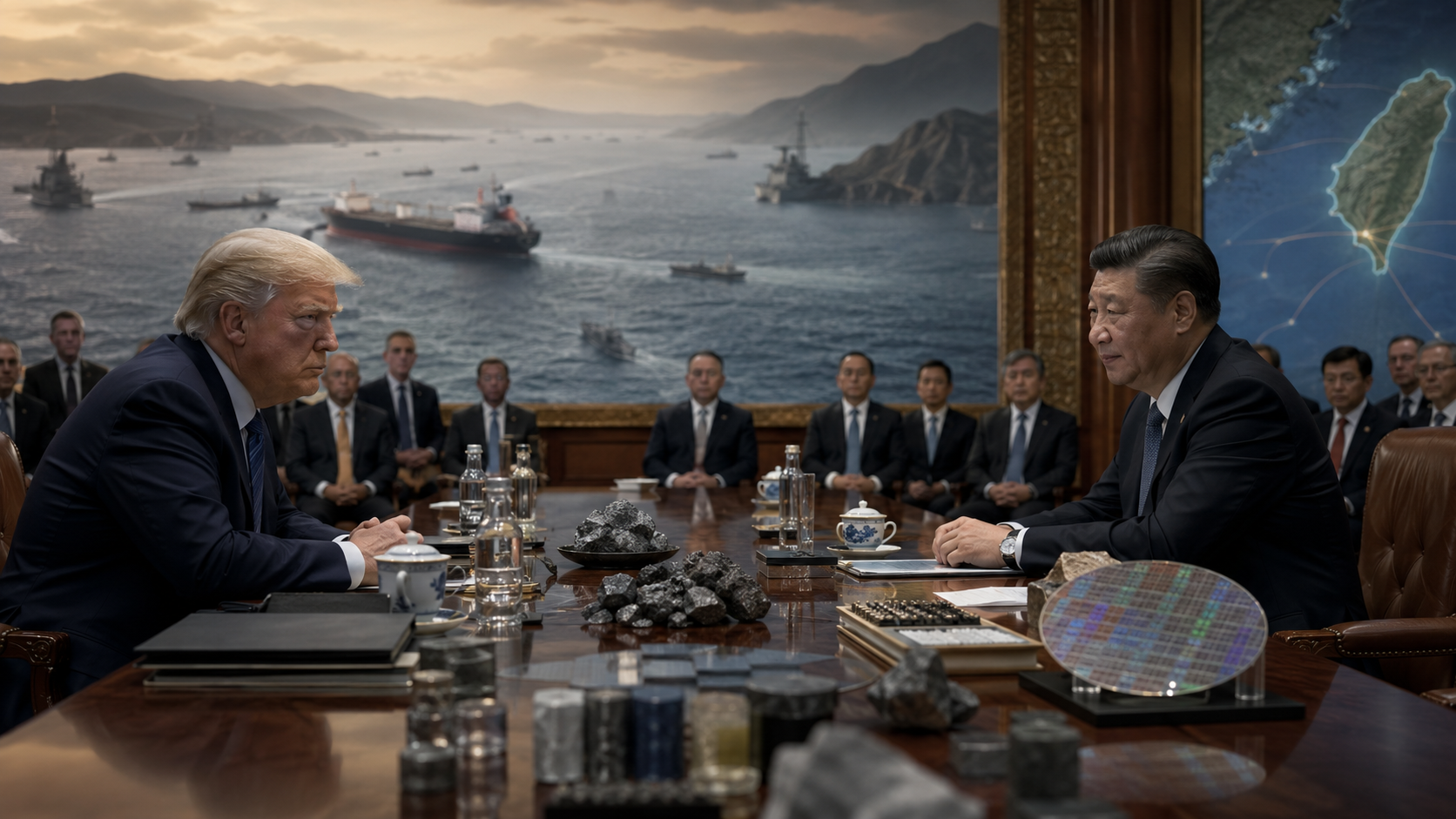
INTELLIGENCE ASSESSMENT
The Trump-Xi Beijing Summit
Asymmetric Leverage and the Structural Limits of Transactional Diplomacy
May 2026 | Geopolitical Intelligence
Executive Summary
The Trump-Xi summit in Beijing on May 13-15, 2026, arrives at the worst possible moment for American negotiating power. The United States enters these talks carrying two structural liabilities. An unresolved military conflict in Iran has destabilized the Strait of Hormuz. A trade war whose costs have fallen disproportionately on American consumers, manufacturers, and defense supply chains has weakened the U.S. position. Beijing has watched this unfold and positioned itself to extract maximum concessions.
This assessment examines the structural power asymmetry defining these talks, China's leverage inventory, the commercial signaling embedded in the U.S. business delegation, probable and improbable outcomes, and the greater strategic danger this summit poses to American decision-making posture.
The Strategic Landscape
Why the U.S. Enters from a Position of Exposure
Trump originally delayed this visit by six weeks. The expectation was that he would arrive in Beijing having compelled Iranian capitulation. A surrendered nuclear program. An open Strait of Hormuz. A geostrategic trophy to display to Xi. None of that happened.
The conflict in Iran remains unresolved. The Strait of Hormuz remains under pressure. U.S. sailors have died. The signal this sends to Beijing is not subtle. The narrative of American strategic decline is gaining observable support in the data.
The Iran conflict is not a regional sideshow. It is a direct lever in the China negotiation. China is Iran's largest oil buyer. The Strait carries roughly 20% of the global oil supply. A closed or partially closed Strait drives energy prices higher across the American economy. Trump needs Xi to pressure Tehran. Xi knows this. That asymmetry is not incidental. It is the defining structural fact of these talks.
China did not arrive at this table without preparation. Every major piece on the board was pre-positioned. This summit is the result.
China's Leverage Inventory
Beijing has assembled a formidable coercive toolkit in the months leading up to this summit. Each element targets a specific American vulnerability.
Rare Earth Export Controls
Since April 2025, China has maintained restrictions on exports of heavy rare earths, including yttrium, dysprosium, and terbium. Exports have run roughly 50% below historical levels. Some prices have increased by as much as 100 times. These materials are critical for F-35 fighter jets, semiconductors, electric vehicles, and advanced defense manufacturing. They represent the material spine of American technological and military capability.
China does not merely mine rare earths. It controls the processing, the magnet production, and the downstream supply chain. That structural chokehold cannot be reversed through tariff policy in any short-term timeframe. The U.S. has pursued diversification for years with limited results. Xi understands the exposure across the Pentagon's F-35 program, hypersonic programs, and domestic EV ambitions.
Pre-Summit Regulatory Escalation
Weeks before the summit, Beijing introduced new trade regulations establishing a legal framework to penalize foreign firms that attempt to relocate sourcing away from China. This directly targets the American decoupling strategy. The timing is deliberate. It is a signal, not an administrative act.
Iranian Oil Defiance
China's Commerce Ministry explicitly prohibited Chinese oil refineries from complying with U.S. sanctions on Iranian crude. This is not an ambiguous position. It is a direct, public act of defiance of sanctions. Beijing has stated, in operational terms, that it will not be coerced through secondary sanctions.
Chinese Satellite Support for Iranian Military Operations
The U.S. sanctioned three Chinese companies for providing satellite imagery that enabled Iranian military strikes against American forces. This happened days before the summit convened. China's complicity in the Iran conflict is documented, not theoretical.
Taiwan Pressure
Beijing has pushed the Trump administration to reduce security commitments to Taiwan and amend U.S. policy on the island. This is a maximalist opening position. Its function is to extract either real concessions or rhetorical softening that can be operationalized later.
The Tech Executive Delegation
Purpose and Strategic Signal
The inclusion of 16 major CEOs is a deliberate, multilayered strategic maneuver. This is not corporate tourism. Each executive's presence carries specific analytical weight.
The delegation includes leaders from firms with deep financial exposure to the Chinese market. Apple manufactures in China. Tesla operates Gigafactories there. Qualcomm generates billions in Chinese revenue. BlackRock holds extensive Chinese investment positions. These executives are not advocates for decoupling. They are a constituency for engagement. Their presence in the room communicates that American businesses want deals.
For Trump, the delegation serves a second function. It creates the appearance of economic substance. Whatever emerges from these talks can be translated into investment agreements, purchase commitments, and commercial frameworks. Trump returns home with headline-ready announcements, regardless of the underlying structural content.
The AI and Semiconductor Dimension
Jensen Huang's presence carries particular weight. The Trump administration has maintained export controls on advanced chips to China. Huang's attendance signals that the question of AI chip export restrictions is on the table. The U.S. may be considering chip export relief as a bargaining concession in exchange for Chinese movement on rare earths or Iran. This is a dangerous trade. Relaxing controls on Huawei or other Chinese entities would accelerate China's AI military capabilities. U.S. defense officials have named this an existential competitive threat.
Qualcomm and Micron illustrate the semiconductor supply chain's acute dependence on Chinese manufacturing and revenue from the Chinese market. China has restricted semiconductor exports through targeted measures, disrupting global supply chains. Their presence signals a desire for de-escalation. China's ask in return, relief from U.S. semiconductor export controls, is something the national security establishment will actively resist.
Elon Musk's presence carries a distinct geopolitical subtext. Tesla's Shanghai Gigafactory is among its most productive globally. Musk has significant financial and political incentives to preserve Chinese market access. His proximity to the president's decision-making creates a channel through which Beijing can influence policy at the margins.
Probable Outcomes
The following outcomes reflect the structural realities of this negotiation, not the optics that will accompany the summit communique.
1. A Modest, Incremental Trade Framework Extension
The most likely outcome is the formalization of the understandings from the October 2025 South Korea summit. Tariff freezes at current levels. Chinese purchase commitments for U.S. agricultural and energy products. Vague language on investment frameworks. The average U.S. tariff on Chinese goods entered 2026 at roughly 31.6%. A deal that meaningfully reduces this would represent a genuine concession. It will not be deep or structurally transformative.
2. A Rare Earth Truce Extension on China's Terms
The most consequential single deliverable may be a further postponement of China's threatened sweeping rare-earth restrictions, which Xi agreed to delay by one year at the South Korea summit. Beijing will likely offer to extend this delay in exchange for U.S. concessions on semiconductor export controls or Taiwan rhetoric. The underlying controls from April 2025 will almost certainly remain in place. China has no incentive to fully release this chokehold. A partial truce is the ceiling, not the floor.
3. Performative Language on Iran
Trump will press Xi on pressuring Tehran to reopen the Strait and end Chinese purchases of Iranian crude. Xi will offer language about regional stability and diplomatic dialogue. China will not genuinely constrain its Iranian oil purchases. These purchases are central to Beijing's energy security architecture and the China-Iran Comprehensive Strategic Partnership. Expect a joint communique referencing support for diplomatic solutions in the Middle East that carries no operational weight.
4. Commercial Investment Announcements
Expect headline announcements of Chinese investment commitments in U.S. manufacturing, U.S. agricultural purchase commitments, and possibly high-profile contract announcements from Apple or Boeing. These will be used domestically to signal the success of deal-making. Some will materialize. Many will not.
5. Narrow AI Governance Language
Given the tech executive presence and the salience of AI competition, some form of joint language on AI risk or a narrow AI safety dialogue framework is plausible. It will be substantively hollow. The deep structural competition in AI military and surveillance applications leaves no room for genuine cooperation.
What Will Not Come from This Summit
The gap between announced outcomes and structural change will define the geopolitical reality going forward. Honest assessment requires naming what this summit will not produce.
No Structural Trade Rebalancing
The deeper sources of rivalry, including industrial policy subsidies, state-owned enterprise advantages, technology-transfer coercion, and intellectual-property theft at scale, will not be addressed. These require years of institutional negotiation, enforcement mechanisms, and sustained political will on both sides. Transactional diplomacy generates communiques. It does not generate structural reform.
No Real Rare Earth Supply Chain Independence
The U.S. cannot diversify rare earth processing capacity in the short term. This is a decade-long project at minimum. Whatever language emerges will not alter the physical reality that China controls the supply chain. The April 2025 controls remain biting.
No Binding Iran Commitment
Xi has no incentive to cut off Iranian oil or pressure Tehran in ways that serve U.S. strategic interests. Iran is a critical node in China's Belt and Road energy security architecture. Beijing is simultaneously running diplomatic dialogue with Iranian officials while publicly defying U.S. sanctions. This is not a negotiating partner preparing to make concessions to Iran.
No Taiwan Detente
Any U.S. softening on Taiwan would fracture alliance relationships with Japan, South Korea, Australia, and the Philippines. These countries calibrate their security postures partly based on signals of American commitment. Taiwan will remain a structural tension regardless of the rhetorical formulations that emerge.
No Semiconductor Export Control Relief with National Security Strings Intact
The U.S. national security establishment will resist meaningful relaxation of advanced chip export controls. Providing access to Nvidia H100- or H200-class chips for Chinese military AI applications represents a hard red line for the Department of Defense. Any concession in this space, if it occurs, will come with verification mechanisms that Beijing will reject.
The G2 Question and Its Dangers
This summit has revived the concept of a bilateral superpower governance arrangement between the U.S. and China. This framing deserves direct scrutiny.
A G2 framework would represent a structural downgrade of the multilateral order. It would marginalize allies, undermine the rules-based international system, and legitimize Chinese revisionist norms as coequal with liberal democratic norms. Any movement toward a G2 dynamic that trades short-term bilateral stability for long-term alliance coherence is a strategic net loss for the United States. It is a windfall for Beijing's project of building a world order with Chinese characteristics.
The Geostrategic Verdict
China enters this summit as the structural winner before the first meeting has occurred.
The United States is militarily engaged in an unresolved conflict. It is economically dependent on Chinese inputs for critical defense and technology sectors. It faces political pressure to produce visible wins before the midterm elections. It enters without the leverage that a coordinated multilateral coalition approach would have provided.
Beijing pre-positioned its rare-earth restrictions, its energy relationship with Iran, and its pre-summit regulatory escalations. It dictates the terms of any deal that emerges.
What Each Party Likely Extracts
Trump will likely extract headline-grabbing commercial announcements, a rare-earth truce extension that keeps the underlying controls intact, and vague language on Iran.
Xi will likely extract ambiguity on Taiwan security commitments, pressure relief on semiconductor export controls, formal legitimization of a bilateral trade governance framework, and the symbolic weight of receiving a sitting U.S. president in Beijing. That last point is not trivial. It is a powerful signal of Chinese centrality to the global order.
The Deeper Danger
What appears to be pragmatic engagement is, in structural terms, accommodation.
The United States has not resolved its dependence on rare earths. It has not rebuilt manufacturing resilience. It has not diversified the semiconductor supply chain. It has not unified allied pressure on China through a coordinated framework.
Every summit that produces incremental deals without structural change extends the dependency architecture that China has deliberately constructed over three decades of patient strategic investment.
Beijing is not in a hurry. Washington is.
That asymmetry in strategic patience is, ultimately, China's most durable form of leverage.