
The international order built between 1944 and 1945, the Bretton Woods financial architecture, and the United Nations Charter framework, are under their most severe structural stress since the end of the Cold War. This is no longer a speculative judgment. The evidence is now empirical, measurable, and convergent across every major pillar of the multilateral system. Institutional output is deteriorating. Legitimacy is eroding. Economic coherence is fraying. These trends are unfolding simultaneously and reinforcing one another.
The UN Security Council adopted only 44 resolutions in 2025, the lowest count since 1991. Its unanimous adoption rate fell to 61.4%, down sharply from a prior decade average of 83.9%. The World Economic Forum’s Global Risks Report 2026, the most comprehensive annual survey of global risk perceptions, now identifies geoeconomic confrontation as the number one immediate global risk. 68% of more than 1,300 surveyed global leaders believe the world will become more fragmented and more multipolar over the next decade. Only 6% expect the post-war multilateral order to be revived. Global debt has reached a record $348T. Developing economies face a $4T annual SDG financing gap. No country on earth is currently on track to achieve all 17 Sustainable Development Goals.
And yet, multilateralism is not dead. It is under severe constitutional stress. The distinction matters. Institutional death implies terminal failure. Institutional crisis implies the possibility of redesign before collapse. The difference between those two outcomes rests on one issue alone. Whether sufficient political will still exists to restructure the system before its failures compound into something harder to contain.
This analysis examines the crisis in full. It outlines the structural drivers behind the current breakdown, the quantitative evidence that shows urgency, the reform frameworks with the strongest analytical grounding, and the role a Decision Signal System (DSS) can play in providing enterprises and executive decision-makers with earlier, more actionable insight into the trajectory of global governance stability.
Part I
The Historical Precedent
Why 1944 to 1945 Still Matters
What San Francisco and Bretton Woods Actually Were
The two founding moments of the modern multilateral order were not exercises in idealistic universalism. They were hard-edged power bargains negotiated among states that had just survived, or won, the most destructive conflict in human history. At Bretton Woods in July 1944, John Maynard Keynes and Harry Dexter White argued over the architecture of the post-war international monetary order. What emerged was the IMF and what would become the World Bank, institutions intended to stabilize a world system shattered by competitive devaluations, financial instability, and the collapse of interwar economic coordination. The San Francisco Conference, held in April through June 1945, produced the UN Charter, a framework that granted the five victorious great powers permanent seats and veto authority as the explicit price of their participation. Universalism was the aspiration. Power was the operating logic.
What made those moments historically exceptional was not goodwill. There was little of it. What made them possible was the scale of the exogenous shock. World War II destroyed the previous order so completely that no serious actor could credibly defend the status quo. The institutional playing field had been cleared by catastrophe. The new powers wrote new rules because the old ones had failed in ways that were undeniable, visible, and irreversible.
The Legitimacy Deficits Were Built In
The legitimacy deficits embedded in both systems were visible from the start. They were tolerated because the geopolitical context allowed it. For roughly two generations, they were manageable. Today, they are corrosive.
The Security Council’s P5 plus veto structure reflected the geopolitical realities of 1945. It excluded newly independent postcolonial states. It froze relative power relationships that would not endure. It created an accountability-free space for the most powerful actors. The Bretton Woods institutions encoded the economic realities of 1944. Their governance formulas privileged industrialized economies at a moment when the Global South had not yet emerged as a coherent political category and when climate change, digital infrastructure, and pandemic preparedness were absent from the development agenda altogether. These were not design errors. They were the terms of construction in a system where universal participation was secured through incumbent privilege.
The problem is not simply that these arrangements were imperfect. The problem is that they remained largely unchanged while the world they were built to govern changed dramatically. Three structural shifts matter most. The first was decolonization and the rise of the Global South, which brought more than 100 new member states into the UN after 1945. The second was the end of the Cold War and the brief unipolar moment, which did not produce any meaningful democratization of the veto structure or any serious redesign of global governance. The third was the emergence of a genuinely multipolar distribution of economic and military power, a shift that now renders both the P5 logic and the Bretton Woods quota formulas structurally incoherent.
Part II
The Empirical Case for Crisis
Data and Metrics
The UN Security Council
A Paralysis in Numbers
The Security Council is the clearest and most data-rich illustration of multilateral breakdown. The 2025 data leaves little room for ambiguity.
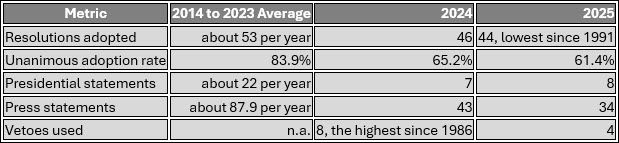
The collapse in output matters because it signals more than disagreement. It signals the shrinking of the space in which agreement remains possible. Forty-four resolutions in 2025, against a prior-decade average above 53, is not a marginal decline. It is evidence of a narrowing capacity to produce even minimal collective outcomes. Deep divisions prevented meaningful Council responses to Gaza, Myanmar, Sudan, and Ukraine, four active and high-casualty crises at the same time. Beyond those headline cases, the Council also failed to translate meetings and consultations into substantive action in response to a coup in Guinea-Bissau, a border conflict between Cambodia and Thailand, India-Pakistan tensions over Kashmir, and rising tensions that culminated in U.S. intervention in Venezuela. No meaningful resolutions. No peacekeeping deployments. No enforcement actions. No serious institutional response.
This is not a temporary dip in effectiveness. It is a structural failure to convert the institution’s stated purpose, the maintenance of international peace and security, into operational output under simultaneous stress.
The Financial Architecture
Inequity at Scale
The economic pillar of the multilateral order is facing two crises at once. One is a legitimacy crisis. The other is a capacity crisis. Together they are producing a system that is less representative, less effective, and less able to respond under pressure.
IMF Governance Inequity
The imbalance in IMF governance is now quantifiable with uncomfortable precision. A March 2025 study found that the Global North holds nine times more voting power than the Global South when adjusted for population. The United States alone controls 16.49% of IMF votes while representing only 4.22% of the world’s population. Because the IMF Articles of Agreement require an 85% supermajority for structural change, the U.S. share functions as an effective veto over institutional reform. The 17th Quota Review, which was expected to redistribute some voting weight toward emerging and developing economies, was quietly pushed from June 2025 to April 2026 at the Spring Meetings. Reform is slowing at the exact moment pressure is rising.
Debt Architecture Failure
The debt picture is no less severe. It is alarming across multiple dimensions at once.
- Total global debt reached a record $348T by the end of 2025, with $29T added in a single year, the fastest annual accumulation since the pandemic
- Developing countries paid out $741B more in principal and interest than they received in new financing between 2022 and 2024, the largest debt outflow gap in at least 50 years
- The combined external debt of low and middle income countries reached an all-time high of $8.9T in 2024
- Emerging markets crossed a record debt ratio above 235% of GDP in 2025
- The average interest rate on newly contracted public debt for developing economies stands at a 24-year high for official creditors and a 17-year high for private creditors
- UNCTAD reports that global public debt alone reached $102T in 2024, growing twice as fast in developing countries as in developed ones since 2010
These figures describe a structural transfer of resources from the world’s most vulnerable populations to global creditors through an architecture those populations have almost no meaningful ability to reform. The issue is not only debt accumulation. It is debt accumulation inside a governance structure that remains profoundly asymmetric.
SDG Failure as Governance Failure
The Sustainable Development Goals, the most universally endorsed development framework in history, now operate as a live scoreboard for global governance effectiveness. The scoreboard is brutal.
- Only 17% of SDG targets are on track to be achieved by 2030
- Only 18% of SDGs are on track in the WEF’s September 2025 assessment
- Nearly half are progressing too slowly and close to one-fifth are actively regressing
- No country on earth is on track to meet all 17 SDGs by 2030
- The annual SDG investment gap for developing countries stands at $4T
- Development aid declined by 7.1% last year, with further cuts expected
SDG 16, Peace, Justice and Strong Institutions, shows especially weak progress. That is not incidental. It is a direct signal that governance failure is no longer peripheral to the development agenda. It now sits at the center of it.
The UN’s Fiscal Crisis
A Canary in the Coal Mine
As of October 2025, 57 member states owed $1.87B out of the $3.5B in mandatory contributions. The United States alone owes $1.5B in regular budget contributions and $2.36B on the peacekeeping budget. As of January 2026, the U.S. accounts for roughly 95% of total outstanding dues. In January 2026, Secretary-General António Guterres warned that the organization was at risk of imminent financial collapse because of unpaid fees. By mid-December 2025, only 148 member states, or 77%, had paid their dues in full.
The system is made more fragile by a financial rule dating back to 1945 that requires unspent budget authority to be returned to member states, even when the shortfall results from nonpayment rather than genuine excess. The result is a structural absurdity. The institution is being financially hollowed out at precisely the moment the polycrisis demands more coordination capacity, not less.
The Power Shift
BRICS vs G7 and What It Means
The economic foundation that once underpinned the legitimacy of Bretton Woods governance and the broader balance of institutional influence has shifted decisively.
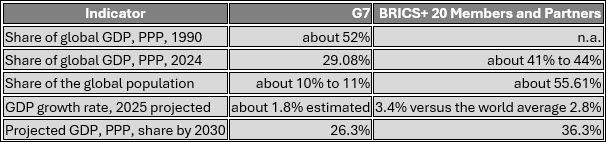
BRICS now includes 10 full members, Brazil, Russia, India, China, South Africa, Egypt, Ethiopia, Indonesia, Iran, and the UAE, plus 10 partner states. Together they account for 43.93% of the global economy on a PPP basis and 55.61% of the world’s population. Even the original five BRICS members now represent a larger share of global GDP on a PPP basis than the entire G7. Yet this shift is barely reflected in the Security Council's composition, the IMF's voting weights, or the World Bank's governance structures. That gap between material reality and institutional representation now sits at the core of the legitimacy crisis.
Part III
The Structural Diagnosis
Why Multilateral Reform Is Exceptionally Difficult
The P5 Constitutional Paradox
The deepest barrier to UN reform is constitutional and brutally simple. Article 108 of the UN Charter requires any amendment to pass the General Assembly with a two-thirds majority and then be ratified by all five permanent members of the Security Council. The five states whose consent is required to reform the system are the same five states that benefit most from the existing structure. There is no elegant procedural workaround to that fact. No permanent member has shown any serious willingness to dilute its veto or accept meaningful competition from new permanent members.
The reform proposals on the table reflect this deadlock. The G4 model, Germany, Japan, India, and Brazil, supports expansion to 25 members with six new permanent seats, but remains divided over whether those new seats should carry veto rights. The African Union’s Ezulwini Consensus demands equal veto rights for any new permanent members, a position that would increase the number of veto-holders to 11 and likely institutionalize even deeper paralysis. The Uniting for Consensus coalition, which includes Italy, Pakistan, South Korea, and others, opposes new permanent seats entirely and prefers longer-term elected seats instead. These three reform visions have been in contention for more than three decades. They still have not produced a consolidated text.
The September 2024 Pact for the Future, adopted by all 193 member states at the Summit of the Future, embedded Security Council reform in Actions 39 and 40. Intergovernmental Negotiations are now being publicly recorded for the first time. Even so, the process remains stuck. India’s representative described the situation accurately. The current format has delivered nothing, adopted nothing, and reconciled nothing. France, despite being a permanent member itself, has acknowledged publicly that the world of 2025 is not the world of 1945 and that reform is clearly needed. The diagnosis is now widely shared. The obstacle is not recognition. It is power.
The Multipolarity-Governance Paradox
Multipolarity creates a second structural problem. The more actors there are with meaningful global influence, the harder it becomes to reach consensus on the design of governance itself. During the brief unipolar moment of the 1990s, U.S. primacy provided the enforcement muscle that made multilateral agreements more credible, even when institutions were poorly designed. Genuine multipolarity has now returned to great power competition without restoring a shared framework for managing it. Strategic Assessment 2025 from the National Defense University concludes that this competition will ultimately drive fragmentation across much of the world into blocs organized around opposing norms, rules, and institutions.
This is not abstract theory. BBVA Research’s 2025 structural indicators show that global fragmentation risk has been rising since 2000, driven largely by the steady increase in trade sanctions and financial restrictions imposed by major powers, including the United States, Russia, China, the United Kingdom, and Europe. The GDP-weighted global Structural Geopolitical Risk index declined from 1960 to 2000. Since then, it has risen steadily and peaked in the early 2020s. The trend line is clear. More actors now possess global reach. Fewer actors share a common framework for how to use it.
The Trust Deficit Runs Deeper Than Institutions
Institutional dysfunction is compounded by a broader collapse in social and political trust, which makes the coalitions required for reform even harder to assemble. The AXA Future Risks Report 2025, based on 26,595 respondents across 57 countries, found that 95% of experts and 93% of the general public believe crises have increased in recent years. Only 19% of experts express full confidence in the authorities’ capacity to manage future crises. Only 11% to 12% of experts believe authorities are well prepared for risks tied to AI, demographic change, or cybersecurity.
And yet the more important finding is this. 67% of respondents still believe international decision-making offers the most effective route to solutions, and 72% remain committed to democratic ideals. The trust deficit is real, but it is not a wholesale rejection of collective governance. It is a rejection of the institutions as they currently operate.
Part IV
Why Multilateralism Is Not Dead
The Case for Reformist Optimism
The Interdependence Floor
The strongest argument for the survival of multilateralism is not moral. It is functional. The world’s current risk portfolio is made up of challenges no state, including a superpower, can manage alone. Climate change, pandemic preparedness, AI governance and safety, nuclear nonproliferation, digital governance, extreme debt distress, and biodiversity collapse all belong to this category. These interdependencies are not rhetorical. They are embedded in physical systems, financial systems, logistics chains, technology stacks, and public health networks.
Even states that weaponize interdependence through tariffs, sanctions, export controls, and technology restrictions continue to depend on the same underlying frameworks that make interdependence economically viable. There is no clean exit from mutual systemic exposure. There is only the choice between coordinated management and mutually damaging fragmentation.
The Pact for the Future
Slow but Real Momentum
The September 2024 Summit of the Future produced three negotiated outcome documents, including the Pact for the Future, with 363 specific follow-up commitments, 261 of which are direct responsibilities of member states. Six UN-wide working groups are now active across Peace and Security, international financial architecture reform, SDG delivery, digital technologies, UN governance reform, and youth and future generations. A high-level steering committee chaired by the Secretary-General is tracking implementation. The Stimson Center’s Global Governance Innovation Report 2025 described the first year of implementation as slow but with visible progress. It highlighted steps toward strengthening the Peacebuilding Commission, sustained momentum on international financial architecture reform after the FfD4 conference, and new work on Beyond GDP measurement.
This is not enough. Civil society is right to argue that the Pact must move beyond symbolism and toward inclusive, accountable, and action-oriented execution. But the existence of a structured reform architecture matters. Five years ago, it did not exist in this form.
The Minilateral Bridge
The Carnegie Endowment’s January 2026 assessment of the middle-power moment describes the two-track path now available to states still committed to constructive multilateralism. The first track is to recommit to UN Charter principles inside formal multilateral institutions, even when great powers choose to drift or obstruct. The second is to build informal, issue-specific minilateral coalitions that can move faster, deepen cross-regional coordination, and create reform pressure inside formal institutions.
The World Economic Forum’s Global Risks Report 2026, while warning of a vacuum in global governance, also documents the rise of minilateralism as a practical bridge mechanism. Smaller and more flexible groups are organizing around shared interests rather than shared values. Examples include the Quad, the International Solar Alliance, the Mangrove Alliance for Climate, and a range of cross-regional connectivity initiatives in the Middle East and South Asia. The central issue is not whether minilateralism is rising. It clearly is. The real issue is whether these coalitions reinforce universal institutions or further displace them. Productive minilateralism should reduce institutional drift, not harden fragmentation.
Part V
The Reform Architecture
What a New Multilateral Moment Requires
Principle 1
Legitimacy Through Proportionality
The most basic legitimacy problem across the multilateral system is the widening gap between who holds decision-making power and where economic, demographic, and geopolitical weight now resides. Any serious reform must confront this directly.
UN Security Council
The most analytically defensible model would expand the Council to 25 members with five new permanent seats, including at minimum one African, one South or Southeast Asian, and one Latin American state. It would also create extended four-year renewable seats for an additional set of regionally representative members, and it would establish a mandatory review process for veto usage with real political cost attached through required public explanation and automatic notification to the General Assembly. A middle-ground formula on veto rights for new permanent members, limiting their veto to matters of direct national interest during an initial period, offers one possible way through the current impasse between the G4 position and the African Union’s demand for equal treatment. France’s 2013 proposal for voluntary veto restraint in cases of mass atrocities should also be revived as a transitional norm.
IMF Reform
The Stiglitz-Rodrik framework for minimal global governance offers a realistic way forward for IMF reform. It argues for a governance formula built around GDP and variability, weighted more heavily toward purchasing power parity and incorporating a stronger compression factor to benefit smaller economies. Doubling Africa’s quota share would require either a 50% overall quota increase with Africa’s share doubled or a direct redistribution from overrepresented members. Because the U.S. retains an effective veto, meaningful reform will require either a coalition of large emerging economies capable of increasing pressure on the threshold or a broader vote trade linked to security and trade architecture bargaining. IMF surveillance should also move toward reciprocity. Major economies, including the United States, should face genuine policy discipline, not only borrowers.
World Bank
The 2025 shareholding review provides an existing channel for rebalancing governance weight toward developing country borrowers that live most directly with the consequences of Bank policy. The principle should be straightforward. Governance weight should align with institutional exposure, not inherited post-war influence.
Principle 2
Architecture for the 21st Century Threat Portfolio
The systems built in 1944 and 1945 were designed to prevent the recurrence of specific failures, interstate wars of conquest and destabilizing monetary competition. The current threat portfolio looks very different. The institutional response must as well.
- AI safety and digital fragmentation. The Global Digital Compact must evolve from political declaration into an operational governance framework with mandatory standards, independent monitoring, and real enforcement for globally deployed AI systems
- Climate governance reform. Weighted or supermajority voting in Climate COP decision-making should be considered to prevent obstruction by a minority of high-emitting states, while a high-level Climate Change Council under UN auspices could help aggregate fragmented climate governance
- Pandemic preparedness architecture. A standing global health security council with pre-authorized response powers, governed through proportional representation, would address the vacuum exposed by COVID-19
- Debt restructuring. The Common Framework must be redesigned to require private creditor participation, compress timelines from years to months, and create automatic standstills for countries in debt distress while negotiations proceed
- A Biennial Global Economic Summit. The Pact for the Future explicitly calls for a standing heads-of-state mechanism for economic governance decisions, a forum capable of bypassing some of the inertia built into IMF Board dynamics
Principle 3
The Stiglitz-Rodrik Minimal Governance Doctrine
The most intellectually honest approach to the gap between what is needed and what is politically possible comes from Joseph Stiglitz and Dani Rodrik. Their minimal global governance doctrine starts from a simple premise. In a world with no supranational government and no global enforcer, institutions must focus on areas where the self-interest of powerful states is sufficient to sustain compliance. That means concentrating governance on the global commons, including climate, digital infrastructure, and pandemic prevention, on rules against deliberately competitive harm such as tax haven abuse, sanctions weaponization, and regulatory races to the bottom, and on dispute resolution mechanisms with genuine bite across trade and financial flows.
This is not a retreat into low ambition. It is an attempt to design a system that can actually hold under present power conditions while leaving open the possibility of broader cooperation if trust later improves.
Principle 4
The Middle Power Coalition Imperative
The political energy for meaningful redesign is unlikely to come from the P5. It is even less likely to come from Washington or Beijing acting out of institutional altruism. It will have to come from a sustained and organized coalition of middle powers and Global South states that represent the interests of most of humanity but do not control the architecture of the existing order. Carnegie’s analysis is right on this point. Specific Pact actions gain momentum when even a small number of committed and diverse governments choose to champion them. The most plausible coalition drivers include the G4 on Security Council reform, the African Union on quota and voice reform, the EU on digital governance standards, and cross-regional coalitions on debt restructuring and climate finance. Middle powers have two real strategic tools. They can remain invested in universal institutions even when great powers drift away from them, and they can build minilateral coalitions that create practical facts the universal system eventually has to recognize.
Part VI
Decision Signal System
Monitoring Multilateral Governance Stability
The deterioration of multilateral governance rarely arrives as a single dramatic break. It unfolds through visible, measurable signals that most firms do not interpret until the consequences have become market-moving events. A Decision Signal System designed for global governance monitoring changes that sequence. It gives executive decision-makers leading indicators instead of lagging headlines and turns geopolitical awareness into structured strategic foresight.
Oxford Economics made the point clearly in its 2026 work on risk signal monitoring. Organizations that fail to anticipate major external shocks almost always share the same core weakness. Their risk processes are too internally generated and too thin on independent, quantitative, specialist external input. The risk management hierarchy moves from operational awareness to situational awareness to strategic resilience. Only the top layer deserves to be called decision intelligence. It is forward-looking, scenario-based, geopolitically grounded, and integrated into executive decision-making.
DSS Signal Architecture
Four Tiers
The following architecture maps global governance indicators into DSS monitoring categories, warning thresholds, and business impact channels. The purpose is not to generate more data. The purpose is to give executives structured intelligence tied to decisions.
Tier 1
Systemic Stress Signals
Governance Output
These signals track the functional output of multilateral institutions. When output declines, governance capacity is weakening. When governance capacity weakens, political risk rises.
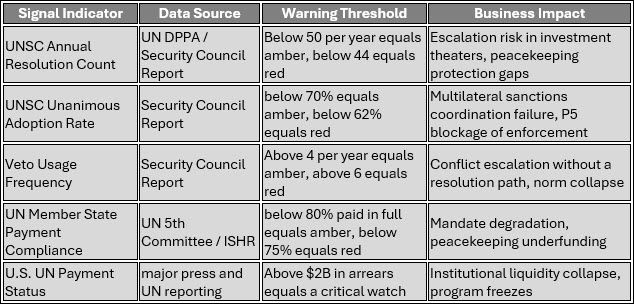
The application is direct. Weekly automated monitoring should be tied to the Security Council Report’s monthly forecast, with alert logic for any Council session involving strategic sectors such as maritime security, energy, or critical minerals that produces no outcome text despite an active agenda.
Tier 2
Economic Architecture Signals
IFA Health
These signals track the health of the international financial architecture. When they deteriorate, access to capital, sovereign stability, and development financing begin to tighten across client sectors.
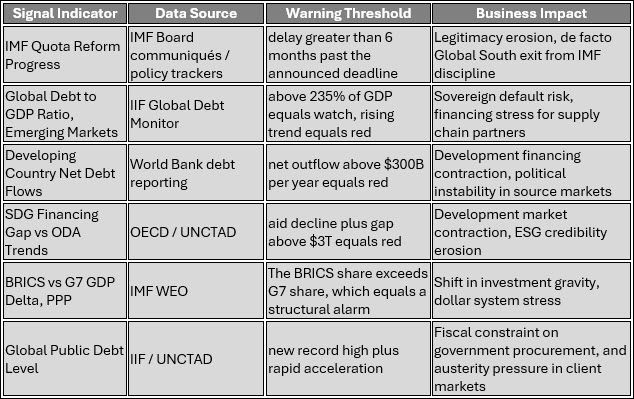
The DSS implication is clear. These indicators should be monitored quarterly, with sector-specific scenario triggers when debt outflows intensify in key manufacturing, logistics, or politically exposed geographies.
Tier 3
Governance Legitimacy Signals
Institutional Confidence
These signals measure whether states, firms, and publics still see formal multilateral institutions as legitimate enough to organize around. When legitimacy weakens, actors start building alternatives. That is how fragmentation moves from theory into institutional fact.
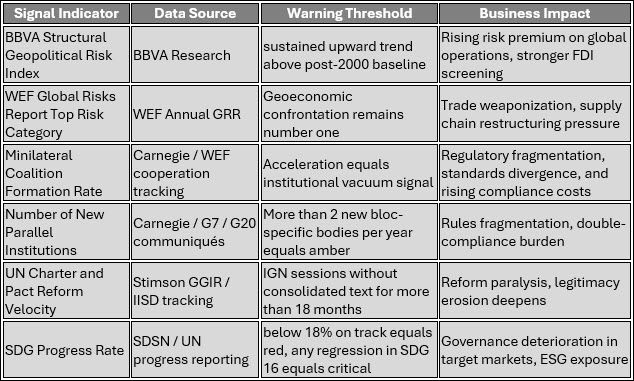
These signals should be recalibrated annually against the WEF report, reviewed semiannually against the Stimson and SDG progress updates, and monitored quarterly for coalition formation and parallel institution growth.
Tier 4
Business Impact Signals
Enterprise-Level Translation
This is where the macro picture becomes operational. These signals translate shifts in global governance into enterprise risk and opportunity indicators.
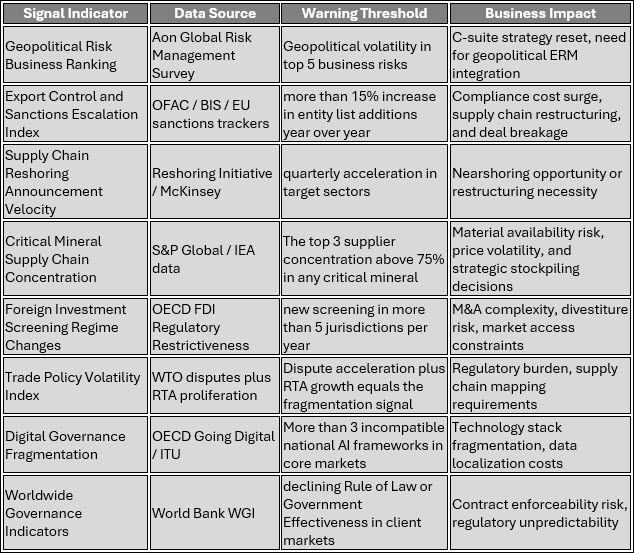
These indicators should be tracked monthly, where possible, with client-specific scenario briefings triggered whenever two or more Tier 4 signals move into amber status within the same geographic theater.
DSS Signal Integration
The Multilateral Governance Dashboard
A practical DSS for global governance monitoring should operate as a signal-to-decision pipeline.
- Signal Collection Layer
Primary data sources, including Security Council practice data, the IIF Debt Monitor, the WEF Global Risks Report, the SDSN SDG Index, World Bank governance indicators, IMF WEO data, and OECD FDI restrictiveness updates, should be monitored on a structured cadence. Tier 1 should be tracked weekly. Tier 2 and Tier 3 should be tracked monthly. Tier 4 should be recalibrated quarterly. - Signal Scoring Layer
Tier 1 through Tier 4 indicators should be rolled into a composite Multilateral Governance Stability score. Tier 1 should carry a 40% weighting due to its immediate decision relevance. Together, Tier 2 and Tier 3 should carry 40% because they shape quarterly strategic planning. Tier 4 should carry 20% because it governs sector-specific and enterprise-specific scenario recalibration. - Threshold Trigger Layer
Preset amber and red thresholds should generate automatic briefing flags. Once the composite score crosses those thresholds, decision-ready briefings should be generated for the relevant sector, geography, or portfolio exposure. - Scenario Translation Layer
Signal combinations should be translated into named strategic scenarios such as Institutional Paralysis plus Debt Crisis Acceleration or Minilateral Fracture plus Sanctions Escalation. Each scenario should include a prebuilt business impact playbook across sectors such as manufacturing, logistics, financial services, technology, and real estate. - Executive Decision Layer
The resulting briefings should feed directly into portfolio governance, go-or-no-go decisions, supply chain resilience planning, capital allocation, and government affairs strategy.
As geopolitical risk rose from rank 21 in 2023 to rank 9 in 2025 in business risk rankings, and is projected to rise to rank 5 by 2028, enterprises without structured monitoring systems are becoming increasingly reactive. The cost of delayed interpretation is rising as trade becomes more weaponized, regulation becomes more fragmented, and reputational flashpoints intensify.
Part VII
Strategic Recommendations
For Global Governance Reform Advocates
- Prioritize Chapter 5 of the Pact for the Future, the roadmap for transforming global governance, as the main vehicle for reform efforts between now and the 2028 Heads of State review. Focus on the six workstreams where progress is measurable, international financial architecture reform, Security Council enlargement, Digital Compact operationalization, Beyond GDP indicators, Peacebuilding Commission strengthening, and youth and future generations representation.
- Build the middle power coalition explicitly. The evidence is clear that specific Pact actions gain traction when a relatively small number of committed and diverse governments choose to sponsor them. A cross-regional coalition of 15 to 20 middle powers drawn from the EU, AU, ASEAN, CELAC, and the G4 would have more structural leverage than any single bloc acting alone.
- Design minilateral coalitions to complement universal bodies rather than compete with them. Minilateralism becomes harmful when it creates separate ecosystems that universal institutions are no longer able to absorb. Productive minilateralism should establish standards, compliance architecture, and market norms that multilateral institutions can later formalize.
- Make the UN fiscal crisis politically costly for delinquent states. The United States owes $3.86B in combined UN arrears. The International Solar Alliance offers a model of how meaningful cooperation can be built even without U.S. leadership. A coalition of states that conditions parts of its investment or trade relationships with delinquent major contributors on payment compliance would create leverage that does not presently exist.
- Reform the IMF before a future crisis sidelines it altogether. Every delay in governance reform increases the incentive for the Global South to deepen alternative infrastructure. The New Development Bank, the Contingent Reserve Arrangement, and emerging BRICS payment architecture are not full substitutes for the IMF, but they are increasingly credible fallback structures. The 17th Quota Review should be completed by April 2026 and linked to a binding commitment to the Biennial Economic Summit mechanism envisaged in the Pact.
For Enterprise Leaders and Chief Intelligence Officers
- Integrate multilateral governance monitoring into enterprise risk management. Fewer than 40% of organizations report robust geopolitical disruption frameworks even as executives rank the risk among their top concerns. Multilateral governance signals offer earlier warning on trade policy volatility, sanctions exposure, investment screening, and supply chain disruption than most firms currently have.
- Commission sector-specific DSS calibration. General thresholds are useful, but different industries experience governance breakdown differently. Manufacturing firms, financial institutions, and real estate businesses do not translate multilateral instability into business exposure in the same way. Industry-specific calibration is what turns raw indicators into decision-ready intelligence.
- Build scenario playbooks for two parallel futures: managed multilateral reform and accelerated bloc fragmentation. These are now the dominant strategic pathways. Firms that prepare for both, including supply chain alternatives, digital compliance structures, and currency or financing hedges tied to dollar system stress, will move faster and with less friction once the trajectory becomes clearer.
- Publish and engage on multilateral reform positioning where material. For firms with global supply chains, multinational operations, or major client exposure in the Global South, the future of multilateral governance is a business condition rather than an abstract policy issue. Thought leadership that links firm strategy to systemic stability builds trust with clients, regulators, and stakeholders before crisis conditions test those relationships.
- Monitor COP30 in Belém in November 2026 as a live bellwether for multilateral reform capacity. The outcomes to watch are not rhetorical. They are structural. Whether climate governance moves toward supermajority voting, whether a high-level Climate Change Council emerges, and whether new financial commitments close even part of the $4T SDG financing gap will tell us whether the reform coalition built around the Pact for the Future has real political weight.
The Stakes of Inaction
The question at the center of this analysis, whether the world needs another San Francisco or Bretton Woods moment, ultimately resolves into a harsher and more uncomfortable conclusion. The world does need such a moment. The problem is that the political conditions required to produce it are harder to assemble than at any point since 1945. The exogenous shock that cleared the way for foundational redesign in 1944 and 1945 was civilizational destruction. The equivalent shocks of the 21st century, COVID-19, climate tipping points, AI disruption, nuclear near-misses, and wider polycrisis cascades, have been severe, but they have not yet been system-clearing in the same way.
What is required now is rarer and harder. Managed redesign before breakdown. Not redesign after total failure. The data already establishes urgency. The architecture for reform, from the Pact for the Future to middle-power coalition-building to a more disciplined doctrine of minimal governance, already exists in outline and, in some cases, in active implementation. The window between institutional crisis and institutional collapse is not fixed, but it is not open indefinitely.
Multilateralism survives not because institutions are well designed or because leaders are idealistic. It survives because the alternative, fragmented blocs, parallel economic architectures, weaponized interdependence, and ungoverned global commons, impose the highest costs on the states and populations least able to absorb them. That shared vulnerability, if properly analyzed, quantified, and translated into decision intelligence, is the foundation on which any future multilateral bargain must be built. The role of a Decision Signal System is to make sure decision-makers see that window clearly, understand its implications early, and recognize it before it closes.