
STRATEGIC INTELLIGENCE ASSESSMENT
Taiwan Strait Theater
A 360-Degree Decision Signal Assessment
Executive Summary
The Taiwan Strait is no longer a future military contingency. It is a live, multi-domain coercion theater. China is systematically shaping the operating environment through military pressure, gray-zone escalation, cyber operations, information warfare, economic coercion, and political signaling. The objective is to alter the balance of resolve before any formal crisis begins.
The central analytical error in most Western and European assessments is treating escalation as synonymous with invasion or blockade. Beijing does not need to achieve substantial strategic gains. Prolonged sub-threshold pressure is the more likely path to coercive success.
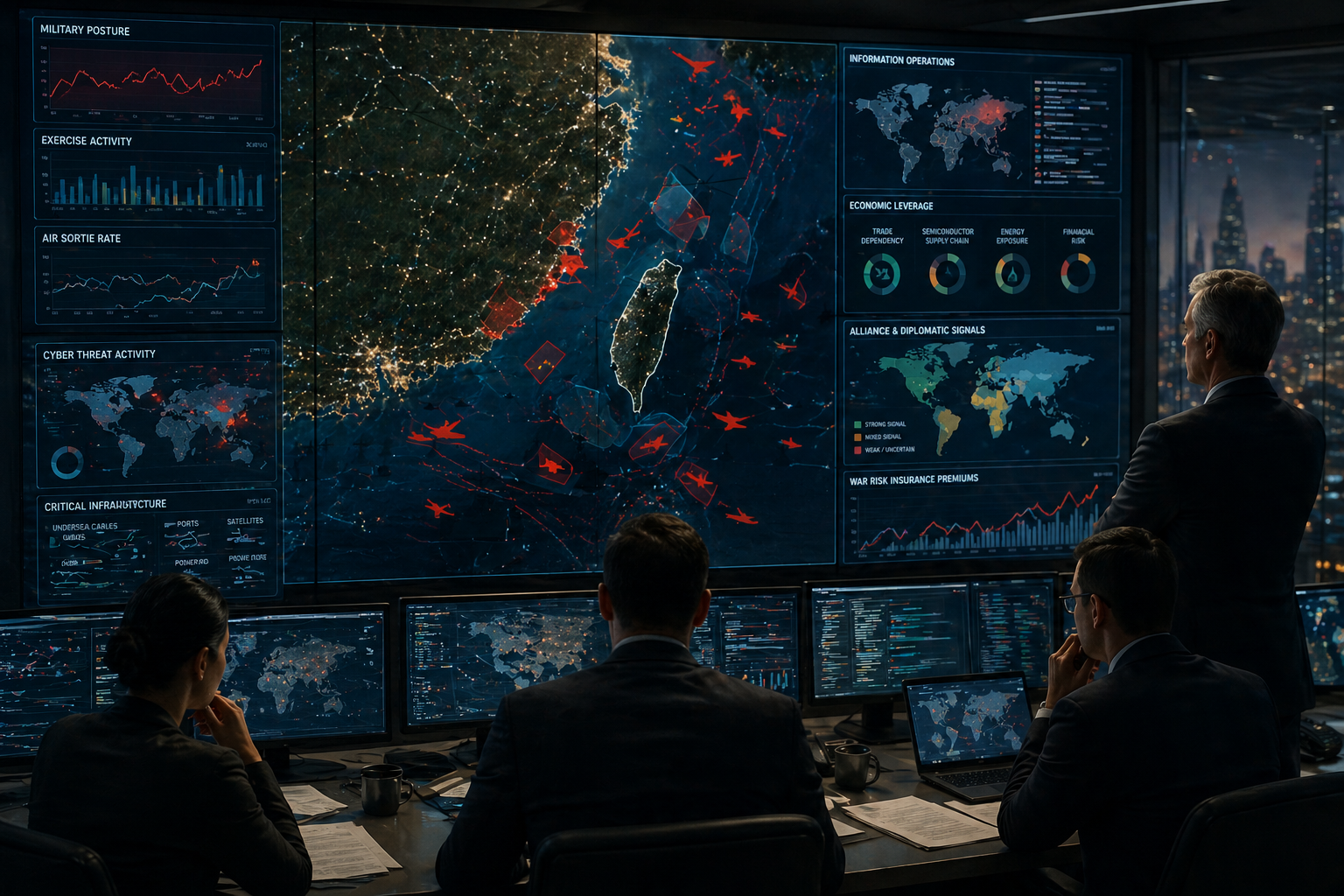
Existing flashpoint indicators track PLA exercise intensity, semiconductor continuity, blockade risk, and war-risk insurance premiums. Those indicators are necessary. They are not sufficient. They capture the visible perimeter of the problem while leaving the more decisive enabling conditions outside the frame: cognitive warfare, cyber pre-positioning, energy vulnerability, undersea infrastructure interference, alliance credibility, and Taiwan's internal political cohesion.
A policymaker relying on four indicators alone could falsely conclude the situation remains manageable so long as no blockade has begun and no semiconductor shutdown has occurred. That conclusion would be analytically indefensible.
Taiwan's risk is not a regional military flashpoint. It is a systems-level global exposure that links European industrial resilience, Indo-Pacific deterrence credibility, semiconductor continuity, energy chokepoints, maritime insurance markets, and the political durability of democratic partners.
This assessment reframes the Taiwan Strait as a contest over coercive advantage rather than a countdown to military action. It pressure-tests three commonly repeated assumptions: the silicon shield as a stable deterrent, blockade as the dominant risk scenario, and European economic deterrence as operationally credible. Each assumption is materially weaker than prevailing policy discussion implies.
The Strategic Problem
The wrong question is whether China can today launch a full-scale amphibious invasion. The right question is whether Beijing can progressively alter Taiwan's strategic environment so that the costs of resistance rise, the credibility of outside support weakens, and the incentives for political accommodation increase.
That distinction changes what policymakers should monitor, what they should deter, and which tools are relevant.
The military dimension of China's pressure campaign is visible. The December 2025 Justice Mission 2025 exercise was the largest military operation ever conducted around Taiwan. It involved naval vessels, aircraft, drones, missile units, and coordinated activity across seven zones surrounding the island. In March 2026, China imposed a 40-day airspace restriction across the East China Sea. Exercises are becoming more sustained, more normalized, and more closely aligned with the logic of blockade rehearsal.
But the visible military activity may not be the most consequential part of the campaign. Its strategic purpose is partly to normalize a new baseline of coercive activity. Future escalatory moves then appear routine rather than extraordinary. That normalization effect is where most analyses fail.
A monthly exercise score may show only a moderate elevation, even as the cumulative strategic meaning of the exercise cycle changes rapidly. Each successive exercise establishes a higher threshold for what counts as unusual. Policymakers become progressively desensitized to the very actions that are building the conditions for coercive leverage. What appears stable may be an advanced form of deterioration.
What the Current Indicators Show
The four existing flashpoint indicators provide an important baseline. They identify military signaling, potential for catastrophic semiconductor disruption, assessed blockade or quarantine risk, and the pricing of conflict risk in maritime insurance markets. These are not trivial signals. They form the core of a serious monitoring framework.
| DSS Indicator | Current Reading | Strategic Meaning |
|---|---|---|
| PLA Exercise Intensity | Elevated | Military pressure continues. Blockade rehearsal normalization is advancing. |
| Semiconductor Continuity | Watch | No confirmed production disruption. Upstream exposure remains acute. |
| Blockade Risk Score | Watch | Gray-zone coercion is active. Full blockade within 12 months is assessed as possible but not dominant. |
| War-Risk Insurance Premium | Watch | Risk pricing rises as insurers extrapolate from Hormuz-style disruption precedent. |
Taken together, these indicators suggest neither calm nor imminent war. They describe an environment of heightened coercive competition in which the most catastrophic scenarios have not yet materialized, but the conditions that could enable them are advancing. That is precisely why a four-indicator framework is too narrow.
Why Four Indicators Are Not Enough
A narrow indicator model works when the threat itself is narrow. The Taiwan challenge is not narrow. China combines military activity with cyber probing, disinformation, legal and diplomatic coercion, political influence operations, exploitation of energy vulnerabilities, and tests of allied commitment.
Any framework that privileges only kinetic and commercial disruption will systematically underdetect the domains in which Beijing achieves strategic progress without paying the price of formal military escalation.
The weakness of the current model is conceptual as much as technical. It assumes escalation occurs through military moves that later lead to economic damage. Beijing's likely preference is the reverse: create political and economic conditions so adverse that Taiwan's room for maneuver narrows before a formal military event becomes necessary.
If that framing is correct, the most policy-relevant signals are not only those that show the crisis has begun. They are signals that China is building the conditions for a crisis that could be won cheaply.
A 360-degree approach requires four additional dimensions beyond the existing indicators: cognitive warfare and information shaping; cyber operations against critical infrastructure; energy and upstream supply fragility; and undersea infrastructure interference. It requires two political-strategic overlays: alliance signaling and deterrence credibility, and Taiwan's internal political cohesion and will to resist.
Without those dimensions, the framework tells policymakers that the Taiwan problem is mostly about ships, chips, and insurance. It is not.
Cognitive Warfare and the Contest Over Perception
The information domain is not secondary to the Taiwan problem. It is one of the principal battlespaces.
Taiwan's security apparatus tracked over 45,000 fake online accounts active in 2025, up from approximately 28,000 in 2024, alongside more than 2.3 million disinformation items disseminated in the same period. This is not background propaganda. It is an industrialized campaign designed to shape public perception, elite confidence, and international narratives before and during periods of military pressure.
What makes this especially important for policymakers is the degree of synchronization between information operations and coercive activity. During Justice Mission 2025, China-linked sources circulated dozens of false narratives, including claims that Taiwan's ports had been quarantined and that PLA forces were operating far closer to Taiwan's shores than confirmed reporting indicated. These narratives were not random. They were rehearsals of crisis framing. They tested whether confusion, panic, and uncertainty could be amplified during an exercise window in ways that might later support a real coercive operation.
A mature flashpoint framework should treat disinformation not merely as an influence problem but as an operational indicator. When narratives about quarantine, infrastructure failure, energy shortage, or political abandonment spike in coordination with PLA activity, those signals belong in the pre-crisis shaping assessment. The issue is not whether the narratives are false. The issue is what strategic condition Beijing is preparing the information environment to accept as plausible.
Cyber Activity as Coercive Pre-Positioning
Cyber operations against Taiwan's critical infrastructure are not episodic nuisances. They are a core element of the coercion architecture.
Security tracking recorded an average of 2.63 million cyber intrusion attempts per day targeting Taiwan in 2025. Cyber escalation coincided with 23 of 40 military maneuvers that year. The energy sector experienced a 1,000% year-on-year increase in cyberattacks, with actors targeting utilities, telecommunications, and infrastructure nodes whose disruption would multiply the effects of any wider crisis.
The central insight is that cyber activity does not merely accompany military escalation. It can prepare the environment for it. If China's preferred strategy is coercion without immediate war, then access to grids, finance, communications, and logistics becomes a low-visibility mechanism for increasing Taiwan's vulnerability while avoiding the political consequences of overt attack.
A power outage, telecom degradation, or financial disruption during a period of PLA pressure would have strategic effects well beyond its technical scope. It would amplify uncertainty, trigger capital flight, complicate mobilization efforts, and intensify domestic political pressure within Taiwan.
Cyber indicators need direct integration into escalation assessment. A rise in cyber activity timed to military exercises carries fundamentally different strategic weight than cyber activity in isolation. The combination of visible coercion and invisible pre-positioning changes the meaning of both.
Energy Vulnerability and the Upstream Risk to Semiconductor Continuity
Much public discussion about Taiwan centers on semiconductors. That focus is justified but incomplete. Taiwan's role in global semiconductor manufacturing remains foundational, particularly at the most advanced process nodes. The operational vulnerability of that production base lies not only in the fabs themselves but in the upstream systems that keep them running: primarily electricity and imported energy.
Taiwan's LNG storage covers only 11 days of domestic supply under current legal requirements. That figure alone should change how policymakers frame the Taiwan problem. Under conditions of sustained disruption, Taiwan's energy system reaches a severe stress point measured in days, not months. Because semiconductor production depends on uninterrupted power and tightly managed industrial inputs, the first-order policy risk is not a hypothetical strike on a fab. It is the possibility that coercion against energy imports, LNG terminals, or maritime transit could halt high-end chip production without a single direct attack on the semiconductor sector.
This upstream vulnerability is especially relevant in the wake of Hormuz disruption dynamics. That precedent demonstrated that shipping disruption is achievable not only through formal blockade but through a risk environment in which insurers, shippers, and operators judge transit increasingly untenable. A similar dynamic applied to Taiwan Strait energy imports would transmit into industrial disruption far faster than most semiconductor-centered analyses assume.
The semiconductor continuity flag is necessary but insufficient. A truly strategic dashboard must track LNG reserve days, energy import exposure, and infrastructure vulnerabilities as the upstream determinants of whether semiconductor continuity can be sustained at all.
Undersea Cables and Hybrid Infrastructure Pressure
Undersea cables are easy to overlook because they are less visible than missile launches or naval exercises. That is precisely why they matter.
Taiwan has experienced repeated cable-cutting incidents involving vessels linked to Chinese operators and operating under flags of convenience. Legislative responses, including requirements for AIS activation and expanded monitoring, reflect the reality that undersea infrastructure has become a target set in gray-zone competition.
The significance of these incidents extends beyond the technical. Cable disruption simultaneously tests attribution, response coordination, legal classification, and resilience. A cable cut can be dismissed as an accident, denied as intentional, and exploited as proof of vulnerability, all at low geopolitical cost to the actor behind it. That makes it an ideal instrument for a coercive campaign designed to probe resolve without crossing a clearly defined line.
Undersea cable interference should be treated as a strategic signal rather than an infrastructure event. It reveals whether China is actively probing the permissive boundaries of hybrid coercion and whether Taiwan and its partners can build resilience against deniable, repeatable disruptions that are politically difficult to retaliate against. A flashpoint model that misses this domain will notice the consequences of hybrid pressure only after resilience has already been degraded.
Alliance Signaling and the Real Deterrence Variable
One of the weakest assumptions in most discussions of Taiwan policy is that deterrence can be assessed primarily by tracking China's military posture. Deterrence depends equally on what Beijing believes about the resolve of the United States and its partners. China does not calculate in a vacuum. It calculates against its perception of coalition behavior, US political will, and the probability that outside actors will impose sustained costs in response to coercion.
That is why alliance signaling belongs inside the flashpoint framework. Recent US posture has introduced contradictory signals into the deterrence environment: strong arms sales and continued military engagement on one side, paired with highly transactional rhetoric and pressure on Taiwan to share the burden on the other. Beijing may interpret these contradictions not as balanced ambiguity but as evidence that Washington's willingness to absorb major costs on Taiwan's behalf is uncertain.
A seasoned skeptic would rightly caution against overstating the immediate consequences of rhetorical inconsistency. Deterrence is not destroyed by a single speech or a single transactionalist remark. But it is shaped by the cumulative interpretation of signals over time. If Beijing concludes that US resolve is weakening even as Europe remains fragmented and Taiwan's defense politics are gridlocked, the strategic environment will change, even if no military balance sheet has shifted materially.
The most important deterrence question is not whether the United States has the capability to defend Taiwan. It is whether China believes the United States would actually do so under crisis conditions, and whether allied cohesion would hold long enough to make coercion prohibitively costly. That belief is a core variable in the system and should be monitored as such.
Taiwan's Internal Political Cohesion
External analyses often treat Taiwan as a passive object of pressure. That is a mistake. Taiwan's internal political dynamics are central to the strategic equation.
Taiwan currently operates under a divided political structure. The presidency and the legislature are controlled by opposing political forces. This division has contributed to the stalling of significant defense budget appropriations and intensified polarization over how Taiwan should respond to Chinese pressure.
The key point is not that democracy produces debate. It does, and that is normal. The problem is that China's strategy is designed to exploit the gap between public support for resilience and elite disagreement over how to achieve it. Beijing's economic inducements toward Taiwanese constituencies, its messaging toward opposition political forces, and its broader cognitive warfare campaign all aim to widen that divergence. If Taiwan's population remains committed to autonomy but its institutions cannot consistently fund defense, harden infrastructure, or build civil resilience, then China gains leverage without needing to change public opinion outright.
The more rigorous question is whether democratic resolve is translating into credible, durable policy outputs under stress. If it is not, what appears to be resilience may be institutional vulnerability.
Europe's Role and the Limits of Strategic Autonomy
For European policymakers and advisory clients, Taiwan should not be treated as a geographically distant issue whose implications would be mediated only through alliance politics. Europe is already economically and industrially exposed to the Taiwan contingency through semiconductor, shipping, and manufacturing dependencies, as well as Chinese leverage over critical inputs, including rare earths.
European legislative bodies have moved further than most member states in recognizing that stability in the Taiwan Strait has direct consequences for European supply chains and security. But the gap between rhetoric and operational policy remains wide. The Anti-Coercion Instrument, designed in part in response to Chinese pressure tactics, has never been invoked against China. European strategic autonomy remains constrained by divergent member-state exposures, domestic political incentives, and uneven willingness to absorb economic retaliation.
The claim that Europe can significantly deter China through economic instruments is plausible in theory. It is much weaker in practice unless Europe demonstrates it can act collectively under stress. China is likely to judge European deterrence less by what instruments exist on paper than by whether major capitals would actually accept short-term economic pain to impose costs on Beijing over Taiwan. That credibility remains unproven.
This does not make Europe irrelevant. It makes Europe's role more specific than most narratives suggest. Europe matters in reinforcing supply chain resilience, narrowing strategic dependencies, clarifying political signaling, and reducing the ease with which China can exploit transatlantic divisions. Declaratory policy alone will not change Beijing's calculus.
Pressure-Testing the Common Assumptions
Any serious policy assessment should challenge its own assumptions. Three require direct scrutiny.
The Silicon Shield
Taiwan's semiconductor centrality does not function as a stable deterrent. There is truth in the silicon shield argument, but it is incomplete. As TSMC expands advanced capacity in Arizona and the United States and others pursue diversification, the strategic hostage value of Taiwan's fabs diminishes marginally. The shield may still deter in the near term. It is not static, and it may weaken precisely as diversification policies succeed.
Blockade as the Dominant Scenario
The evidence suggests that prolonged gray-zone coercion may be more attractive to Beijing than a formal blockade, because it generates strategic gains while avoiding the coalition responses a declared blockade would trigger. Policymakers who fixate too narrowly on the probability of a blockade may miss the more likely scenario in which China achieves cumulative erosion without crossing that threshold.
European Economic Deterrence
European economic deterrence is not yet credible in the form needed to decisively shape Beijing's behavior. Instruments matter only if the target believes they will be used. Europe has not yet demonstrated that level of cohesion in response to Chinese coercion. These challenges sharpen the policy framework rather than invalidate it. The focus should be less on dramatic end-state scenarios and more on whether the enabling conditions for coercive success are being allowed to accumulate unchecked.
A 360-Degree Indicator Framework
A complete framework preserves the existing four indicators and layers in additional domains that capture the less visible but strategically decisive parts of the coercion architecture.
| Domain | Recommended Signal | Why It Matters |
|---|---|---|
| Military | Exercise cadence normalization | Captures the strategic effect of repeated exercises, not just monthly intensity. |
| Information | Cognitive warfare index; disinformation narrative flag | Identifies coordinated perception shaping and crisis rehearsal in the information domain. |
| Cyber | Critical infrastructure cyber flag; cyber-kinetic correlation score | Detects low-visibility preparation for high-impact coercion. |
| Energy | LNG reserve day count; energy chokepoint exposure | Tracks the upstream system that could halt fabs and trigger broad instability. |
| Infrastructure | Undersea cable incident rate; shadow fleet proximity | Measures deniable hybrid pressure against communications resilience. |
| Alliance | US commitment signal score; coalition coherence score | Monitors the deterrence variable Beijing is actually reading. |
| Taiwan Internal | Political cohesion score; will-to-resist proxy | Distinguishes societal resilience from institutional capacity. |
| Europe | EU policy coherence score; ACI readiness flag | Assesses whether Europe’s deterrent posture is real or declaratory. |
The value of this expanded framework is not analytical completeness for its own sake. It is the ability to detect multi-domain convergence. A single elevated indicator can mean many things. Several elevated indicators moving together across military, cyber, information, energy, and political domains signal something categorically different.
Decision Implications for Policy and Advisory Clients
Conceptual Discipline
Taiwan should not be monitored as a narrow military contingency. It must be understood as an integrated geopolitical risk system. The right question is not whether China will invade in 2026 or 2027. The right question is whether the conditions under which coercion could succeed are strengthening or weakening.
Distinguish Catastrophic from Deterioration Signals
A semiconductor shutdown or formal blockade represents catastrophic disruption. Rising cyber correlation, worsening political cohesion, deteriorating LNG reserve conditions, or repeated cable interference are signals of deterioration. The latter often matter more precisely because they do not command immediate headline attention.
Connect Geopolitical Analysis to Operational Resilience
For advisory clients, the key question is not only what China might do. It is how Taiwan-related risk transmits into supply continuity, procurement costs, insurance pricing, capital allocation, and strategic dependency exposure. For governments, the question is how to align policy signaling, economic resilience, and alliance coordination before a crisis compresses decision time.
Resist Confirmation Bias in Both Directions
It is a mistake to assume war is imminent. It is equally a mistake to assume that because invasion is not imminent, the situation is stable. The Taiwan Strait is in a phase of cumulative strategic conditioning. That phase is dangerous precisely because it can be misread as something less than a crisis.
Final Assessment
The Taiwan Strait is best understood as a contest over coercive advantage rather than a countdown to a single military event. China's strategy appears designed to alter risk perceptions, degrade resilience, test political cohesion, and narrow Taiwan's options without triggering the kind of formal escalation that would unify an external coalition against it. That makes traditional crisis indicators necessary but insufficient.
A four-indicator flashpoint model is a solid foundation, not an adequate end state. It captures the visible perimeter of the problem while leaving several domains in which Beijing can achieve the greatest leverage at the lowest immediate cost entirely outside the frame.
A 360-degree model is not an exercise in analytical completeness. It is the minimum necessary architecture for understanding a coercion problem that is already unfolding across the military, cognitive, cyber, energy, infrastructure, political, and alliance domains simultaneously.
Taiwan risk should now be treated as a standing strategic management issue, not an episodic crisis topic. The right question is no longer whether the Taiwan issue matters beyond the region. It is whether policy and business leaders are monitoring the right signals early enough to act before the visible crisis arrives.
| RIDGELINE ADVISORY GROUP | Geopolitical Intelligence & Strategic Advisory | Decision Signal SystemThis document is prepared exclusively for executive and policy audiences. All analysis is proprietary to Ridgeline Advisory Group. |
|---|