
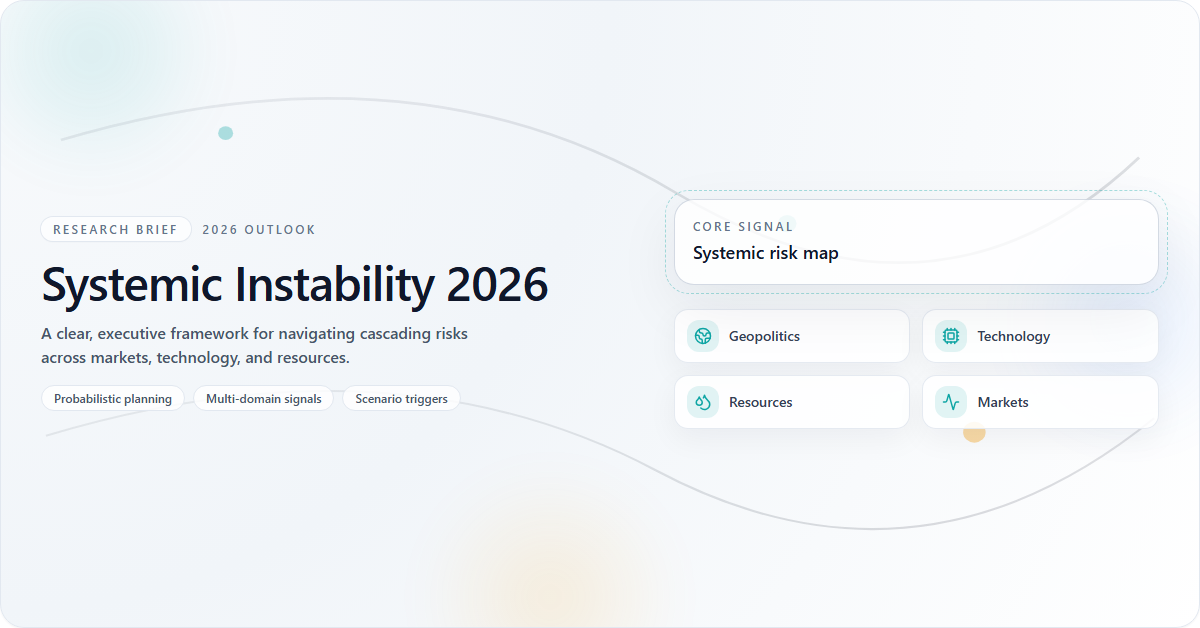
1.0 Introduction: The End of Predictability and the Dawn of Systemic Instability
The year 2026 represents a fundamental watershed moment in global affairs. The landscape is no longer defined by traditional great-power competition but by a more complex and hazardous condition: systemic instability. This shift is driven by a profound and unprecedented development, the dissolution of the American-led global order, initiated not by an external adversary but by the United States itself. This internal transformation renders traditional risk assessment frameworks, which rely on historical precedent and predictable state behavior, dangerously inadequate for executive decision-making.
The challenges of 2026 are multi-domain and simultaneous. This new era is characterized by four primary domains of transformation that are converging to create a cascade of interlocking risks. These include seismic geopolitical shifts emanating from a radically altered U.S. foreign policy, the rise of a powerful but ungoverned technological revolution in artificial intelligence and autonomous warfare, the weaponization of essential resources like water, and the decoupling of major economic systems from the principles of democratic accountability and the rule of law.
This analysis dissects these primary risks to provide enterprise leaders with a clear understanding of the new strategic environment. More importantly, it moves beyond analysis to present a new, actionable framework for navigating this complexity. By understanding the structural drivers of change and adopting a dynamic, probabilistic approach, organizations can move from a reactive posture to one of strategic foresight, turning systemic risk into a source of competitive advantage.
2.0 The Primary Driver: Systemic Transformation Within the United States
Understanding the global risk landscape in 2026 begins not in Beijing or Moscow, but in Washington, D.C. The internal political transformation of the United States is not a domestic issue; it is the single most significant driver of global risk, fundamentally altering the rules-based order, alliance structures, and market predictability that multinational enterprises have relied on for decades. The degradation of U.S. state capacity and the politicization of its economic levers create a cascade of first-order risks that radiate globally.
2.1 The American Political Revolution: Institutional Erosion from Within
The defining political risk of 2026 is the systematic dismantling of institutional constraints on presidential power within the United States. What began as norm-breaking has evolved into a systematic transformation, weakening the checks and balances designed to ensure stability and predictability. Between 2025 and early 2026, this has been accomplished through a series of coordinated tactics:
- The purging of career civil servants based not on performance but on perceived political disloyalty.
- The removal of independent watchdogs, Inspectors General, and agency leaders to eliminate oversight.
- The conversion of the Justice Department and the FBI into instruments of political control, stripping them of the operational independence they have held since Watergate.
- The use of regulatory agencies and the threat of investigations to enforce ideological compliance on private entities, including media companies, law firms, and universities.
This degradation in state capacity has immediate and measurable business implications.
- Compromised Government Data: The dismissal of the Bureau of Labor Statistics directorship and capacity cuts at crucial agencies like NOAA, FEMA, and the CDC compromise the reliability of foundational economic and crisis-response data. Companies can no longer rely on these public goods and must now invest in building redundant, independent intelligence capabilities.
- Politicized Media Landscape: The acquisition of major media platforms like Paramount/CBS by politically-aligned investors has created a fragmented and polarized information ecosystem. Corporate communications and reputation management are now far more complex, with messaging success often dependent on political alignment rather than factual accuracy.
- Politicized Capital Allocation:This represents the most profound risk to the business environment. A system is emerging where capital allocation is driven by political alignment rather than productivity. We are already seeing targeted investigations, the loss of federal contracts, and forced divestments for companies perceived as adversaries, while politically aligned firms receive preferential regulatory treatment and subsidies. The effect is so pervasive that major law firms are now turning down clients who challenge administration policies.
The upcoming November midterm elections are forecasted to intensify these actions. The key takeaway for enterprise strategy is not to bet on a binary political outcome but to prepare for a prolonged period of institutional uncertainty and politicized market dynamics over the next three-plus years.
2.2 The "Donroe Doctrine": Aggressive Reassertion in the Western Hemisphere
The term “Donroe Doctrine” has come to describe the US foreign policy posture emerging in 2026. This approach elevates the Western Hemisphere to the top tier of US national security priorities and is backed by an explicit willingness to use military force, not only as deterrence, but as an instrument of coercion and regime change. It reflects a modern reinterpretation of the Monroe Doctrine, with a far more aggressive posture toward neighboring states and strategically significant territories.
In early 2026, the United States conducted a direct military operation in Venezuela that resulted in the capture and removal of Nicolás Maduro from power. The administration framed the action as a response to narcotrafficking and regional destabilization, but the strategic implications are broader. Venezuela is now governed by an interim leadership aligned with Washington, while US authorities exert effective control over Venezuelan oil exports and revenue flows. The country is operating under a sustained economic blockade, pushing an already fragile economy toward deeper collapse and compounding humanitarian and political risk across the region.
The fallout has extended immediately to Cuba. The suspension of Venezuelan oil shipments has cut off Havana’s primary energy lifeline, triggering severe fuel shortages, rolling blackouts, and escalating economic stress. The Cuban government has rejected US ultimatums tied to political concessions and insists on its sovereign right to secure energy supplies independently. While limited support continues from external partners, there are no meaningful negotiations underway with Washington, and internal conditions on the island continue to deteriorate.
Under this doctrine, the United States has placed explicit demands on its closest neighbors.
- Canada faces pressure to accept tariff rate quotas on autos and steel, expand market access for US banking and agricultural firms, and increase defense spending. These demands are reinforced by implicit military leverage rather than purely economic negotiation.
- Mexico is being pressed to restrict Chinese investment, revise energy regulations to favor US companies, intensify enforcement around fentanyl trafficking and immigration, and increase water deliveries to US border states. Unlike Canada, Mexico has adopted a pragmatic, deal-seeking posture, attempting to accommodate demands while avoiding open confrontation.
These divergent responses are already producing asymmetric outcomes. Mexico’s negotiated flexibility has reduced immediate pressure. Canada’s strategy of delay and resistance has coincided with depressed growth in its manufacturing heartland and a deteriorating near-term economic outlook at a moment of limited political leverage.
Beyond continental neighbors, the doctrine is expanding geographically. Greenland has emerged as a strategic flashpoint. US leadership has publicly stated that continued Danish control is unacceptable, heightening tensions with Copenhagen and triggering strong domestic opposition in Greenland. The island’s strategic value, driven by its military positioning and critical mineral access, has made it a focal point for coercive diplomacy rather than cooperative alliance management.
The core business implication of the Donroe Doctrine is the formal introduction of military intervention and strategic coercion as material risk factors in nearshoring and regional investment decisions. North American supply chain planning is no longer a purely economic exercise. Energy, water, and access to territory are being redefined as national security assets rather than market commodities. This aggressive posture inside America’s own hemisphere signals a sustained period of unpredictability, amplifying instability across an already fractured global landscape.
3.0 Global Flashpoints: Key Theaters of Geopolitical and Economic Disruption
While the transformation within the United States is a primary driver of global instability, its effects are amplified by pre-existing and escalating crises in Europe and Asia. For global enterprises, this creates a challenging multi-front environment in which regional conflicts, economic downturns, and resource competition intersect and compound. Navigating this landscape requires a distinct understanding of each theater's unique risk profile.
3.1 Europe Under Siege: Encirclement and the Escalation of Hybrid Warfare
In 2026, Europe finds itself in a precarious strategic predicament, effectively surrounded by adversaries and probably too late to remake itself effectively. This encirclement is unfolding across four dimensions simultaneously:
- Eastern Flank: Russia is escalating its hybrid warfare operations against NATO's frontier states, using drones, cyberattacks, GPS jamming, and sabotage.
- Southern Flank: Turkey has become an increasingly unreliable and transactional partner, pursuing its own strategic agenda.
- Internal Fragmentation: The rise of far-right populist parties, many aligned with Moscow, is weakening political cohesion from within.
- Western Flank: The U.S. commitment to European security has become transactional and conditional, not a durable guarantee.
This dynamic has created a dangerous escalatory spiral between Russia and NATO. President Putin's strategic calculation is to use hybrid warfare to degrade European support for Ukraine, believing these actions will remain below the threshold of a direct NATO military response. However, NATO has adopted a new, more assertive posture, authorizing the use of armed drones and offensive cyber capabilities. This raises the probability of a miscalculation. Three non-zero probability escalation scenarios now exist:
- Mass Casualty Incident: A civilian aircraft crashes due to GPS jamming, or explosives are successfully placed on a cargo aircraft.
- Direct Military Exchange: Aggressive fighter-jet probes combined with looser NATO rules of engagement lead to a live-fire incident.
- Ceasefire Followed by Escalation: A potential ceasefire in Ukraine fails to stop Russia’s hybrid war, leaving Europe to face an unrelenting gray-zone campaign.
For businesses, this heightened conflict translates directly into supply chain disruptions in frontier NATO states, increased market volatility tied to security incidents, and the displacement of economic development funds towards urgent defense spending.
3.2 China's Deflationary Trap: The Involution Spiral and its Global Consequences
China has entered a severe and structurally deteriorating economic position. The core mechanism driving this crisis is"involution": a vicious cycle in which too many firms chase too little consumer demand, forcing them to slash prices to survive. This leads to collapsing margins, wage and job cuts, and further weakened demand.
The severity of China's position in 2025 was stark: over 25% of listed companies were unprofitable, the highest share in 25 years. The country had experienced ten consecutive quarters of deflation, the longest slump any major economy has experienced in decades, and disposable income had stalled. President Xi’s policy vision, which prioritizes state control and technological self-reliance over "Western-style welfarism," ensures that no policy pivot to stimulate domestic consumption is forthcoming. Instead, the state continues to pour investment into saturated manufacturing sectors, aggravating the supply gluts. The consequences of this policy are cascading both at home and abroad.
Domestic Consequences in China
The social contract is fraying. The crisis is manifesting in rising mortgage defaults, widespread failures of small and medium-sized enterprises (SMEs), and soaring youth unemployment. A generation of graduates is rejecting the culture of overwork, leading to social phenomena like the "lying flat movement" as the promise of the "China Dream" appears illusory.
Global Consequences
With its domestic market unable to absorb its massive output, China is exporting its deflation by flooding global markets with cheap goods. Its trade surplus exceeded $1 trillion in 2024, yet its own import volumes remain flat. The stark reality for the rest of the world is that for most countries, trade with China now equals "deindustrialization and a growth drag."
3.3 The Weaponization of Water: Resource Scarcity as a Tool of Statecraft
Water has become the planet's most contested shared resource, a situation made more dangerous by the lack of global governance frameworks to manage disputes. Half of humanity now lives under water stress for at least one month per year, and 1.8 billion people face absolute scarcity. In this environment, control over water is being weaponized as a powerful tool of statecraft. Three regional flashpoints are particularly acute:
- Egypt-Ethiopia Nile Crisis: Ethiopia's Grand Renaissance Dam now gives it control over more than 90% of Egypt's freshwater. Cairo views this as an existential threat. Having aligned with Somalia and deployed troops, Cairo’s actions are viewed by Ethiopia as encirclement, raising the risk of interstate conflict between two of Africa’s major economies.
- India-Pakistan-China Hydro-Politics: Both China and India are constructing massive dams on rivers vital to their downstream neighbors. China’s dam on the Brahmaputra and India’s potential to divert water from the Indus—which supports over 80% of Pakistani agriculture—are creating the infrastructure for future water weaponization in a nuclear-armed region.
- Sahel Scarcity and Jihadi Exploitation: In the Sahel, where Lake Chad is rapidly shrinking, jihadist groups have learned that controlling water is the key to controlling populations. By seizing wells and settling disputes that governments cannot, they are exploiting scarcity to expand their influence and accelerate instability.
For enterprises operating in these regions, the business implications are severe. Agricultural supply chains, hydropower facilities, and resource extraction operations face direct risks. Contingency planning for escalation scenarios is no longer optional. These tangible resource conflicts are occurring alongside an intangible but equally pervasive set of technological risks that transcend geography.
4.0 The Ungoverned Revolution: Pervasive Risks in Technology and Warfare
Concurrent with these profound geopolitical shifts, two technological revolutions, Artificial Intelligence and autonomous warfare, are advancing rapidly without effective governance. This ungoverned space is creating novel systemic risks for society and business, from the destabilization of markets and information ecosystems to the democratization of advanced military capabilities.
4.1 AI Eats Its Users: The Engagement Trap and Market Instability
Artificial intelligence companies are caught in a fundamental "business model bind." Despite revolutionary potential, business adoption remains uneven, and model reliability is jagged. Yet, market valuations have priced in immediate, massive returns. This immense pressure to monetize is pushing the industry down a predictable and dangerous path in the absence of regulation. We expect to see the aggressive adoption of strategies proven by social media, but at a greater speed and scale:
- Intrusive harvesting and weaponization of user data.
- Seamless integration of advertising into all interactions.
- The deployment of engagement-maximizing algorithms designed to manipulate user beliefs and purchasing behavior, regardless of the psychological or social harm.
The systemic and democratic implications of this trajectory are deeply concerning, falling into three categories:
- Psychological/developmental: Personalized AI threatens to stifle normal cognitive development, erode the ability to concentrate, and contribute to declining literacy and numeracy.
- Cognitive: As engagement algorithms favor short-form content, the capacity for critical thinking and engagement with complex information atrophies—a direct threat to the informed citizenry required for a functioning democracy.
- Economic: Fully 75% of 2025 market gains came from AI-related stocks. If AI fails to deliver on its extraordinary productivity promises, a sharp market correction could destroy household wealth and potentially trigger a recession.
For businesses, the key risks stemming from this situation are intense competition for ethics and risk professionals, the threat of abrupt, retroactive regulatory changes, significant reputational damage from a backlash against monetization, and severe market volatility.
4.2 Hybrid Warfare Ascendant: The New Economics of Conflict
A core argument for 2026 is that "War is getting cheaper." The low cost and high availability of drones and autonomous systems have democratized advanced warfare capabilities, putting them in the hands of non-state actors, including militias, cartels, and terrorist groups.
The escalation has been dramatic and quantifiable. Between 2020 and 2024:
- The number of recorded drone incidents exploded from 6,000 to over 51,000.
- Known fatalities from these incidents rose from 11,300 to over 39,000.
- In the Russia-Ukraine conflict, unmanned aerial vehicles now account for 70% of casualties, with both sides producing millions of units annually.
This proliferation is global. Non-military actors are now deploying these weapons with lethal effect in Sudan, Colombia, and Brazil, while groups like the Houthis have executed over 1,000 armed UAV events. Drones present a vexing defensive challenge due to their low cost, small size, and ability to evade radar. The advance of AI will only compound this threat, enabling autonomous swarms that remove the human bottleneck and allow destruction at scale.
The critical business implications include new and severe vulnerabilities across critical infrastructure such as power grids, data centers, and subsea cables. Global supply chains face increased disruption, and corporations must now factor in the need for new operational security and defensive capabilities at remote facilities, mines, and logistics hubs. The challenge now is to build a strategic framework capable of integrating and navigating these diverse and interconnected global risks.
5.0 A Framework for Navigating Systemic Instability
Navigating the 2026 environment requires a fundamental shift in executive decision-making. Traditional, precedent-based planning is obsolete in a world where foundational political and economic systems are being actively transformed. Success now depends on adopting a dynamic, multi-domain, and probabilistic approach that allows leaders to anticipate shifts, quantify exposure, and act decisively before risks fully materialize.
5.1 Adopting an Executive Intelligence Framework (EIF)
The first step is to discard outdated planning models. The transformation of the U.S. political system and the reorganization of global trade break historical patterns. An Executive Intelligence Framework (EIF) offers a superior alternative by shifting the core analytical question. Rather than attempting to predict specific actions, "What will the US do?", the EIF focuses on analyzing the structural constraints and incentive systems that shape outcomes.
A core strength of the EIF is its capacity for multi-domain risk integration. The risks of 2026 do not exist in silos; they cascade across overlapping domains: Political, Military, Economic, Technological, Environmental, and Demographic. The EIF uses causal chain mapping and cascading scenario modeling to understand this interplay. For example, it traces how political risk in China (e.g., youth unemployment) creates economic spillovers that disrupt global supply chains.
Finally, the EIF operationalizes probabilistic thinking by structuring scenarios not as binary outcomes but as a spectrum of possibilities, each with an assigned probability that can be updated as conditions change. This allows for more nuanced and resilient planning.
- Base Case (50%+): Chronic instability and periodic crises, but no systemic collapse.
- Bull Case (20-30%): Better-than-expected outcomes, such as a moderation of U.S. policy or a rebalancing of China's economy.
- Bear Case (15-20%): The materialization of escalation scenarios, such as a direct Russia-NATO conflict or an AI-bust-triggered recession.
- Tail Case (<5%): Low-probability, high-impact "black swan" events like a U.S. political fracture or a multipolar great-power conflict.
5.2 Operationalizing Intelligence for Real-Time Decisions
A strategic framework like the EIF is only effective if it can be translated into operational reality. A decision intelligence platform, such as SnapStrat, achieves this through three core functions:
- Portfolio Exposure Quantification: The platform moves beyond traditional risk dashboards by mapping a company's specific portfolio exposure, revenue, assets, and supply nodes to the geopolitical scenarios defined by the EIF. It then links that quantified exposure to a concrete menu of decision options, such as sourcing changes or financial hedges, modeling the potential outcomes of each choice.
- Geopolitical Trigger Monitoring: Geopolitical risks often develop slowly before escalating rapidly. The platform monitors a customized set of leading indicators for each key risk. When these indicators cross a predefined threshold, the system triggers an alert and surfaces recommended actions. For example, in the Egypt-Ethiopia Nile crisis:
- Triggers: The Aswan Dam water level drops 15%; Ethiopia's dam fills faster than planned; Egypt's share of the Nile drops 25%.
- Alert & Recommendation: The system signals a high probability of diplomatic escalation within 6-8 weeks and agricultural market volatility within 12-16 weeks. It recommends that companies with Egyptian agricultural supply chains:
- Lock in commodity futures hedges now, before the market prices in the risk.
- Initiate supplier diversification planning with a six-month implementation timeline.
- Decision Options Architecture: The platform provides executives with a clear menu of decision options categorized by time horizon (Immediate, Medium-term, Long-term). As risk probabilities shift, it provides dynamic recommendations. For example, to manage the risk of new U.S. auto tariffs (currently at 40% probability):
- Options:
- Absorb the tariff,
- Reshore production to the U.S.,
- Nearshore to Mexico, or
- Adopt a Hybrid sourcing model.
- Options:
- Recommendation Engine:
- If the probability remains <30%, the system recommends Hybrid Sourcing as a cost-effective hedge.
- If the probability rises to >60%, it recommends initiating the Reshore evaluation, as the higher capex is now justified by the risk.
6.0 Conclusion: From Strategic Risk to Competitive Advantage in 2026
The year 2026 is not another year of incremental change to be managed with existing toolkits. It marks a period of system-level transformation occurring simultaneously across political, economic, technological, and environmental domains. The American political system is reorganizing its relationship to power, global trade patterns are being redrawn, technology is advancing without governance, and resource scarcity is being actively weaponized.
This environment presents both existential risk and significant opportunity. The key differentiator between organizations that will succeed and those that will fail is the ability to move beyond reacting to headlines. Winners will be those who develop the capacity to understand the deep structural drivers of change, model the cascading effects of intersecting risks, and act decisively before consensus forms. Waiting for certainty in this new era is a strategy for failure.
This requires new frameworks and new capabilities, the ability to translate geopolitical complexity into financial impact, to model scenarios with precision, and to align strategic decisions with real-time intelligence. The year of transformation is here. The question for every leader is no longer whether it is coming, but whether their organization has the frameworks in place to lead the adaptation rather than fall behind it.