
FLASH BRIEF UPDATE
Islamabad Talks Collapse
Post-Collapse Escalation Trajectory and Revised Scenario Set
April 12, 2026
Decision Signal System Update
SITUATION UPDATE
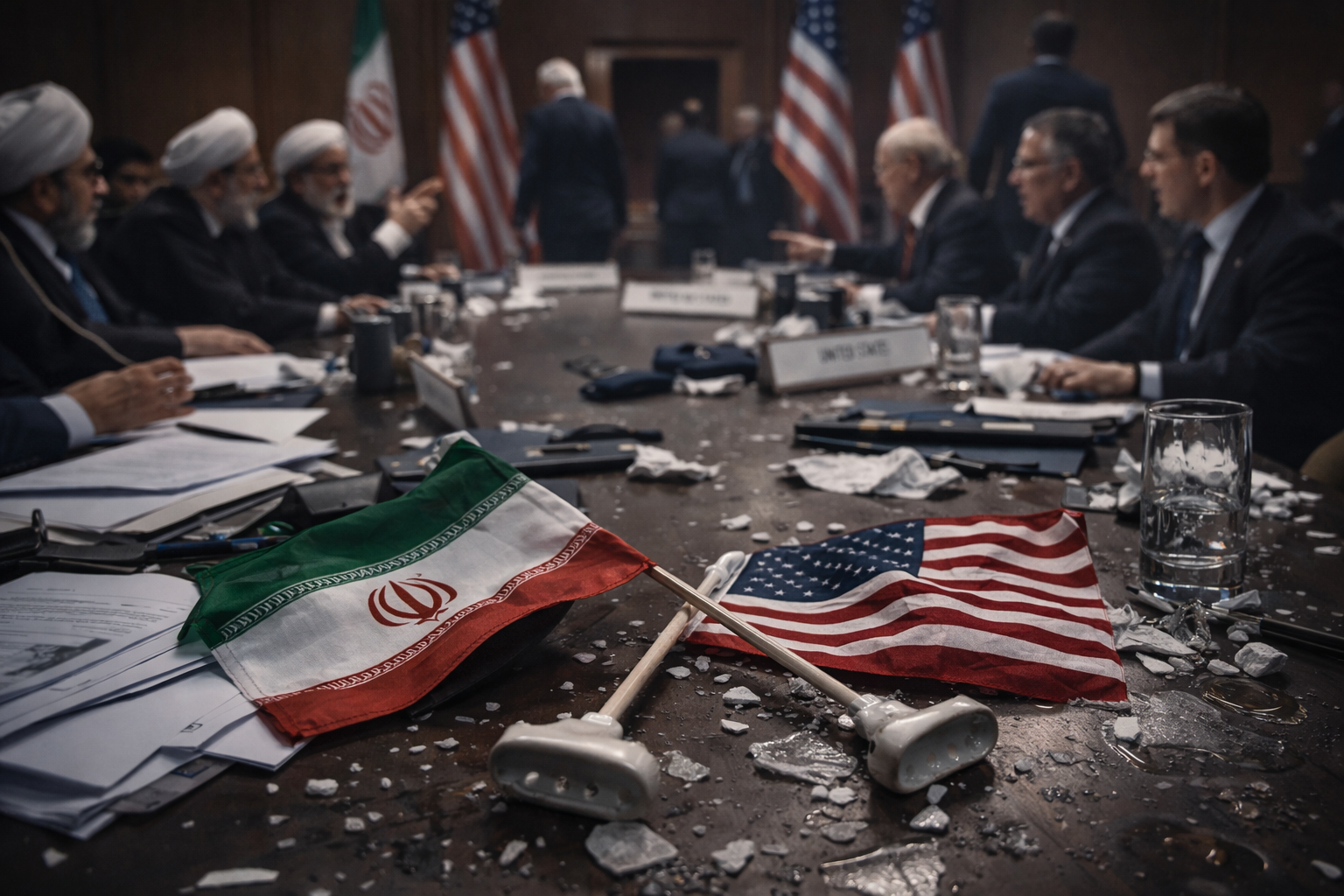
The United States and Iran concluded 21 hours of direct face-to-face negotiations in Islamabad on April 10 and 11 without reaching an agreement. This was the highest-level bilateral contact since 1979. Vice President JD Vance announced the collapse in Islamabad before departing on Air Force Two.
Vance's stated reason for the breakdown was direct: the U.S. required a clear commitment from Iran to refrain from pursuing a nuclear weapon and the means to rapidly develop one. Iran refused. Iran's Foreign Ministry countered that the failure stemmed from the U.S.'s excessive demands and refusal to recognize Iranian rights.
Parliament Speaker Ghalibaf, leading the Iranian delegation, said his team had introduced forward-looking proposals but that the U.S. had not earned Iran's trust. Turkish reporting indicated that negotiations over the Strait of Hormuz grew so tense that Ghalibaf and Witkoff nearly came to blows.
The post-collapse escalation moved faster than expected. While talks were still underway, CENTCOM dispatched two guided-missile destroyers into the Strait of Hormuz, the first naval entry since the war began on February 28. On April 12, President Trump formally declared a U.S. blockade of the strait. The two-week ceasefire, agreed five days prior, now hangs in the balance.
PREDICTION AUDIT: WHAT THE APRIL 9 ANALYSIS GOT RIGHT
The collapse in Islamabad validated nearly every structural vulnerability flagged in the April 9 Flashpoint. The gaps were architectural, not political.
| April 9 Prediction | April 12 Outcome |
|---|---|
| Iran would enter with pre-built exit ramps via ceasefire violation claims | Iran accused the U.S. of three ceasefire violations before talks began; Ghalibaf used final warning and illogical framing throughout |
| Witkoff would make technical errors or contradictory statements | Reports of Witkoff and Iranian counterparts nearly coming to blows over Hormuz confirmed the inability to manage structural disagreement professionally |
| Lebanon’s linkage would threaten the negotiation early | Lebanon remained a core Iranian demand throughout; ongoing strikes were cited as a continuous ceasefire breach |
| U.S. message discipline would be a vulnerability | Trump posted on Truth Social during live negotiations, declaring Iran was losing big, directly undermining the U.S. position at the table |
| The enrichment red line would prove unbridgeable without technical expertise | Nuclear weapon commitment became the single stated reason for the breakdown |
| Scenario 1 (collapse) was the highest-probability outcome | Talks ran 21 hours and collapsed. Late Scenario 1 with elements of attempted Scenario 2 that failed |
The 21-hour duration matters. Both sides tried to bridge the gaps. Iran acknowledged an understanding on several matters. This was not an instant walkout. It was a sustained exhaustion of the available deal space. The deal came closer than either side has publicly acknowledged.
THE NUCLEAR COMMITMENT: WHY IT BROKE THE TALKS
The specific formulation that broke Islamabad is analytically significant. Vance did not say Iran refused to stop enrichment. He said Iran refused to commit not to seek a nuclear weapon. That is a narrower demand than the one the U.S. entered with, suggesting concession movement over the 21 hours.
Iran's refusal to provide even a no-weapon commitment reflects a deeper structural reality. Iran's parliament was already debating the withdrawal from the NPT before the talks began. The Foreign Ministry had publicly stated it was reviewing its exit from the NPT as early as March 30. If Iran has already politically moved toward treating the NPT as expendable, committing to a no-weapon assurance in a bilateral deal with a country it completely distrusts was never going to happen, regardless of who sat across the table.
Iran's nuclear doctrine is in active transition from deterrence-by-ambiguity to deterrence-by-capability, accelerated by the U.S.-Israeli strikes on its nuclear infrastructure. A negotiating team with the technical architecture to craft face-saving language might have kept Iran within a commitment structure. The Vance-Witkoff-Kushner team did not. The 21 hours confirmed it.
THE STRAIT OF HORMUZ: FROM CHIP TO FLASHPOINT
Hormuz has moved from a diplomatic bargaining lever to an active military confrontation zone. This is the most consequential development of the past 72 hours.
Iran has controlled the strait since February 28, charging over $1M per ship, blocking unauthorized transit, and mining the waterway. During the Islamabad negotiations, while Vance and Ghalibaf were still at the table, CENTCOM dispatched destroyers to transit the strait and begin mine-clearing. Iran disputed the crossing and warned that any military vessel attempting to transit would be dealt with severely.
The timing was almost certainly read by Ghalibaf as deliberate contempt for the process. Sending warships into the kill box of a contested strait while the lead negotiator is still at the table is either extraordinary strategic pressure or a fundamental failure of process coordination between the White House and CENTCOM. The effect is the same. Iran's delegation left the room, having been shown that Washington was escalating militarily even as it was negotiating diplomatically.
Trump's post-talks blockade declaration goes further. He ordered the Navy to interdict every vessel that had paid a toll to Iran. This is no longer a negotiating posture. It is a declared escalation posture with kinetic dimensions.
Critical operational detail: Iran reportedly lost track of the mines it planted and is physically unable to fully reopen the strait even if it wanted to. Iran's leverage tool has become a trap. Hormuz standoff may continue regardless of diplomatic agreement because implementation is technically impossible for Iran to guarantee.
The international dimension further complicates the blockade. Russia and China vetoed a UN Security Council resolution on April 7 aimed at reopening the strait. A U.S. unilateral blockade operates without UN legitimacy, against two P5 powers, in a waterway through which China imports a significant share of its energy. Blowback from Beijing and Moscow will be significant and immediate.
REVISED SCENARIO SET: SECOND-ORDER OUTCOMES
The original four scenarios are obsolete. Scenario 1 has occurred. The question is no longer whether talks succeed. It is how this war ends, and through what pathway.
| Scenario | Probability | Description / Key Trigger |
|---|---|---|
| S1. Hot Hormuz Incident Restarts War | HIGH | Mine detonation, IRGC fire on a U.S. vessel, or a misidentified drone strike compels Trump to authorize infrastructure strikes. Trigger: CENTCOM mine-clearing encounters IRGC response beyond radio warnings |
| S2. Extended Standoff with Coercive Pressure | MODERATE | Prolonged military standoff with freedom-of-navigation operations and Iranian tolls. Ceasefire nominally intact but increasingly fictitious. Trigger: Whether the blockade is implemented as announced or de-escalated via back-channel |
| S3. Iran Accelerates Nuclear Program, Exits NPT | SIGNIFICANT (medium timeline) | Parliamentary legislation was ready for a vote before talks. The collapse removes the strongest argument against that vote. Trigger: NPT withdrawal vote or credible intelligence of weapons-grade enrichment |
| S4. Back-Channel Reconstruction, Technical Talks | LOW-MODERATE (2-6 weeks) | Pakistan or Oman reconstitutes a back channel. Technical experts replace political principals. Trigger: Mediator announces scheduled follow-on meeting |
REVISED WARNING MATRIX
| Status | Conditions |
|---|---|
| BLACK | IRGC fires on a U.S. vessel or the U.S. strikes Iranian infrastructure. Iran withdraws from the NPT. Full hostilities resume. Proxy network fully reactivates |
| RED | Naval confrontation without casualties. Iran threatens but does not execute infrastructure strikes. Ceasefire declared void. Proxy attacks escalate beyond pre-ceasefire levels |
| AMBER | Blockade not yet implemented. Standoff continues with radio warnings. Rhetorical optionality preserved. Back-channel contact ongoing. NPT vote deferred |
| GREEN | Mediator reconstitutes contact. Technical follow-on talks announced. Mine-clearing proceeds without IRGC resistance. Ceasefire reaffirmed. NPT vote abandoned |
Current status as of April 12: AMBER trending toward RED.
The blockade declaration and naval confrontation have not yet resulted in a kinetic exchange, but the conditions for one are present. The ceasefire is nominally in place. The NPT withdrawal vote has not yet been held. All conditions are live and unresolved.
FORWARD WINDOW: WHAT COMES NEXT
Immediate (April 12-17)
The most dangerous period is the next 72 to 96 hours. Three overlapping pressure points drive it: the operationalization of the blockade declaration, CENTCOM mine-clearing encountering IRGC resistance, and the formal expiry of the two-week ceasefire around April 21. If Washington does not either walk back the blockade or produce a ceasefire-saving back-channel within this window, the risk of a naval incident grows with each day.
Trump's behavior during and after the talks, posting on Truth Social while negotiations were live, attending a UFC fight rather than monitoring the outcome, and issuing a maximalist blockade declaration within hours of the collapse, suggests the White House is operating without a disciplined crisis management framework. The absence of Secretary Rubio from the delegation reinforces that the diplomatic chain of command has structural gaps.
Near-Term (April 17 - May 15)
If a kinetic incident is avoided, the next phase is coercive bargaining. Washington uses the blockade and military superiority to pressure Iran toward U.S. terms. Iran uses NPT withdrawal and proxy reactivation to maintain its leverage floor. Pakistan, Oman, or Qatar will attempt to mediate technical-level talks. The ceasefire's formal expiry around April 21 creates a natural forcing function.
Medium-Term Strategic Questions (May - August 2026)
Four questions define the next phase. First, nuclear threshold: will Iran cross to weapons-grade enrichment as a deterrence strategy? Second, proxy network viability: will Iran fully reactivate Hezbollah, Iraqi militias, and the Houthis? Third, coalition fracture: Does a Chinese energy disruption from the blockade push Beijing from rhetoric to material support for Iran? Fourth, Iran's internal stability: Does external pressure consolidate or fracture regime authority under the new supreme leader?
DECISION IMPLICATIONS
The Islamabad collapse is not merely a diplomatic failure. It is confirmation that the U.S. entered without the tools to succeed and is now escalating through mechanisms that carry serious kinetic risk and no clear diplomatic endgame.
The most dangerous strategic dynamic is an escalation ratchet without a diplomatic ladder. Washington has increased pressure through the blockade while walking away from the table. Iran faces the choice of capitulating to maximum pressure, which Ghalibaf has signaled is politically impossible, or escalating militarily to restore deterrence. Neither path leads to a settlement. Both paths lead to a hotter conflict.
The fundamental lesson of the 21 hours is that the gaps between U.S. and Iranian positions are not primarily due to a lack of political will. There are gaps in the technical architecture, trust-building, and procedural credibility. Those gaps can only be bridged by specialized expertise the current U.S. team does not possess. Sending the same team back would compound the error. The blockade strategy, implemented without a parallel diplomatic track led by credible technical experts, risks transforming a dangerous military standoff into a full resumption of hostilities, this time without even a nominal ceasefire to constrain it.