
Modern enterprises are drowning in dashboards, forecasts, reports, alerts, and AI-generated insights. Yet during disruption, most organizations still hesitate at the exact moment speed matters most.
The problem is rarely visibility.
The problem is constructing executable decisions under uncertainty, not just uncertainty from execution risk, but external uncertainty driven by geopolitical, macro-economic, competitive, or technology changes.
Most organizations can identify signals. Fewer can determine when a signal actually requires action. Fewer still can coordinate thresholds, triggers, ownership, scenarios, constraints, and execution across the enterprise.
We call this "The Execution Gap". That gap is where strategic decisions begin to fail.
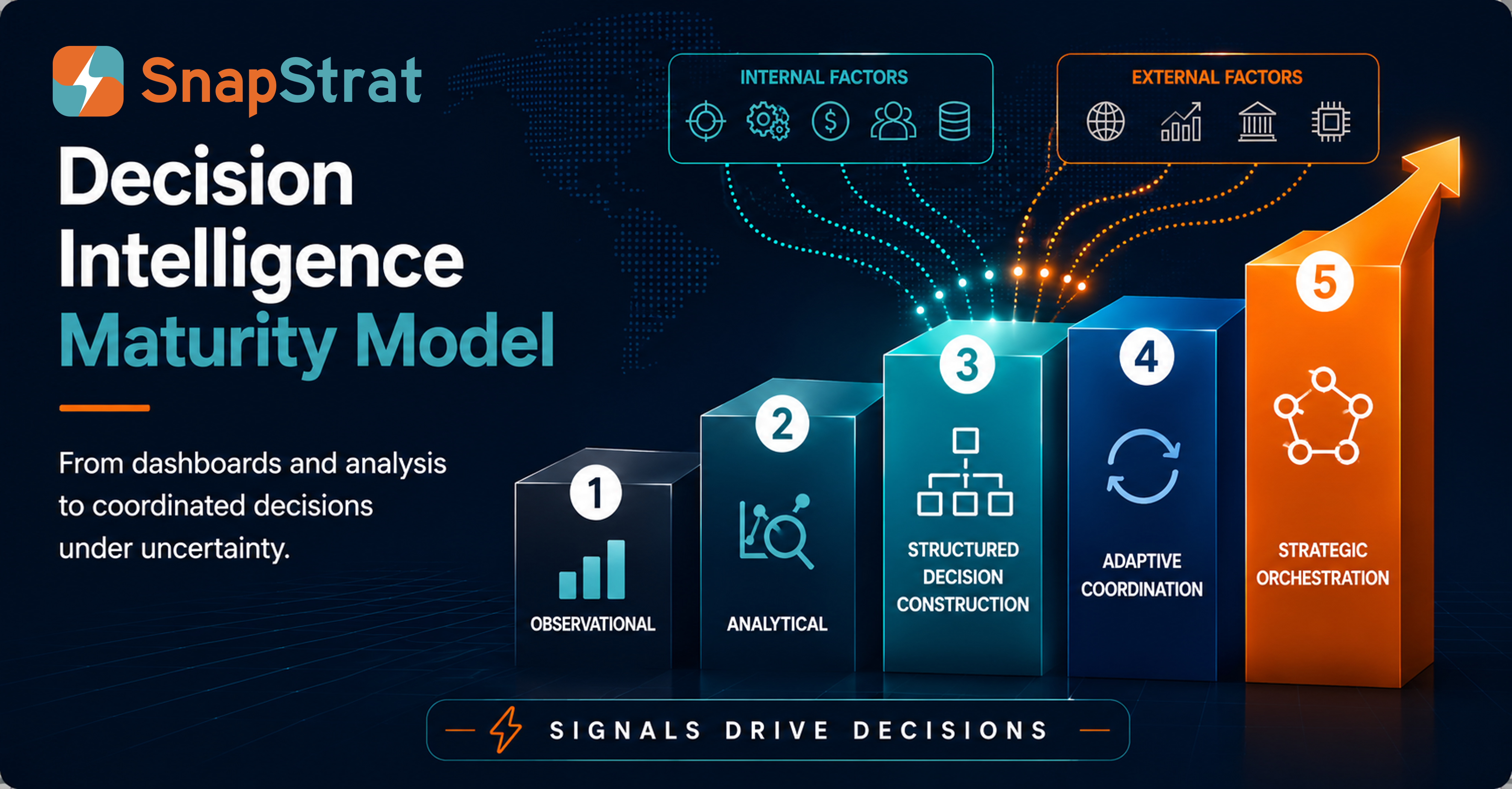
The SnapStrat Decision Intelligence Maturity Model focuses on the most important decisions organizations can make, planning decisions. It describes the progression from reporting and analytics toward adaptive, coordinated decision systems that continuously convert signals into action.
Why Most Maturity Models Miss the Real Problem
Most maturity models focus on:
- Data quality
- Analytics sophistication
- AI adoption
- Workflow automation
Those capabilities matter. But they are not the primary constraint in modern enterprises.
Executives rarely struggle because they lack dashboards.
They struggle because:
- Assumptions conflict across teams
- Tradeoffs remain implicit
- Escalation paths are unclear
- Thresholds on when to change paths are undefined
- Ownership becomes fragmented under pressure
- Resource allocation cannot adapt quickly enough
- Organizations pause when conditions move fast
- External forces are acknowledged, but rarely explicitly baked into the decision calculus
Most organizations have analytical maturity.
Very few have decision maturity.
That distinction matters because seeing uncertainty and acting under uncertainty are fundamentally different capabilities.
The Shift From Insight to Action
Most organizations stop at insight.
They:
- Detect signals
- Analyze outcomes
- Compare scenarios
- Generate recommendations
But recommendations alone do not create speed.
High-performing organizations go further. They define:
- Which indicators matter. both internal and external
- When a signal crosses a threshold
- What action gets triggered
- Which scenario response activates
- Who owns the decision
- How resources reallocate
- When escalation occurs
Signals alone do not create execution.
Pre-wired decision systems do.
This is the shift from analytical maturity to operational decision maturity.
The Decision Intelligence Maturity Model
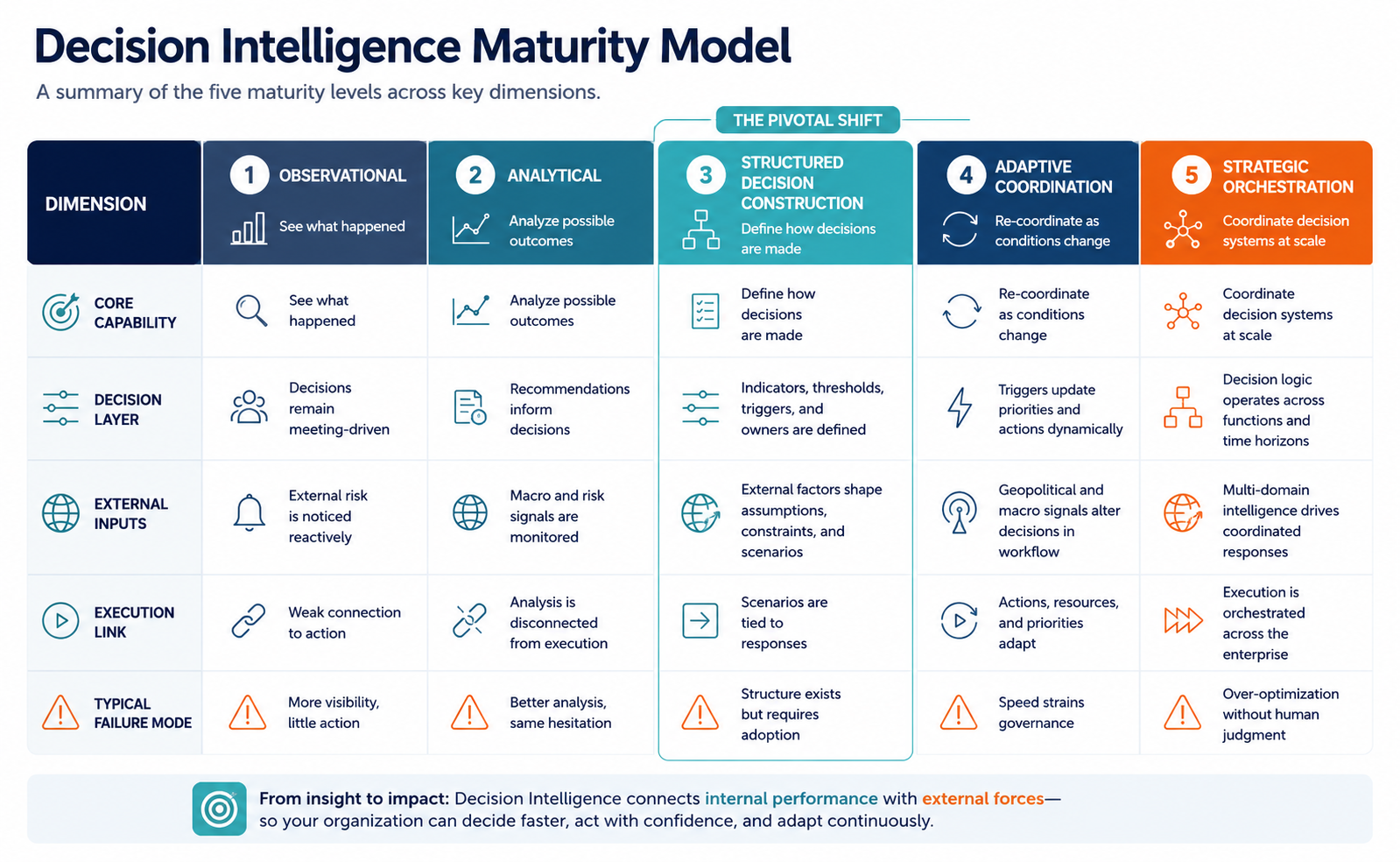
Stage 1 — Observational
Core characteristic
The organization explains the past.
What is done
- KPI dashboards
- Standard reporting
- Ad hoc analysis
- Historical performance reviews
How it is done
- Spreadsheet-driven processes
- Siloed functional reporting
- Manual coordination
- Meeting-driven decisions
External inputs
- External risks monitored inconsistently
- Macroeconomic conditions discussed periodically
- Geopolitical disruptions handled reactively
- Weak visibility into external exposure
Decision reality
Signals are primarily informational.
The organization sees problems after impact has already occurred.
Common outcome
Visibility improves, but organizational responsiveness does not.
Stage 2 — Analytical
Core characteristic
The organization analyzes possible outcomes.
What is done
- Forecasting and predictive models
- Scenario analysis
- Business intelligence tooling
- Functional optimization
How it is done
- Historical data modeling
- Periodic scenario reviews
- Siloed analytical workflows
- Recommendations disconnected from execution
External inputs
- Macro indicators monitored
- Geopolitical risks tracked through reports and news
- Scenario planning introduced
- Risks flagged qualitatively
Decision reality
The organization understands more, but still struggles to act quickly.
Signals improve awareness without reducing hesitation.
Common outcome
Better analysis.
Same decision bottlenecks.
Stage 3 — Structured Decision Construction
Core characteristic
The organization explicitly defines how decisions are made.
This is the pivotal shift in Decision Intelligence maturity.
Organizations move from analyzing decisions to constructing decision systems.
What is done
- Decision criteria explicitly defined
- Assumptions documented and tested
- Constraints modeled
- Tradeoffs surfaced and prioritized
- Uncertainty bounded through scenarios
- Decision logic made inspectable and repeatable
How it is done
- Structured decision frameworks
- Assumption and constraint management
- Cross-functional decision logic
- Thresholds and triggers embedded into workflows
- Scenarios linked to operational responses
External inputs
- Geopolitical and macroeconomic risks integrated into planning
- Policy, regulatory, and supply chain signals connected to decisions
- External volatility modeled directly into assumptions and constraints
- Risk scenarios tied to allocation and sequencing decisions
Decision reality
Signals stop being informational.
Signals begin triggering action.
The organization now defines:
- What matters
- When action is required
- What happens next
- Who owns the decision
Common outcome
The organization begins acting with consistency under uncertainty rather than debating from scratch during every disruption.
Stage 4 — Adaptive Coordination
Core characteristic
The organization continuously re-coordinates decisions as conditions change.
What is done
- Dynamic scenario updates
- Continuous reprioritization
- Adaptive allocation decisions
- Integrated execution workflows
- Real-time trigger rules
- Adaptive decision flows
- Connected operational systems
- Continuous feedback loops
- Governance models designed for rapid adjustment
External inputs
- Geopolitical and macro signals continuously monitored
- Early warning indicators integrated into workflows
- Commodity, regulatory, and supply chain disruptions incorporated dynamically
- External changes continuously reshape assumptions and priorities
Decision reality
The organization adapts decisions continuously rather than periodically.
Thresholds, triggers, and allocation decisions evolve as conditions change.
Common outcome
The organization reduces hesitation during disruption because escalation paths and responses already exist before the disruption occurs.
Stage 5 — Strategic Orchestration
Core characteristic
The organization coordinates interconnected decision systems across the enterprise.
What is done
- Enterprise-wide decision orchestration
- Coordinated resource allocation
- Integrated capital, GTM, supply chain, and operational planning
- Continuous learning across decision systems
- System-level optimization and governance
How it is done
- Standardized decision interfaces
- Orchestration layers across functions
- Scenario-linked operational playbooks
- Embedded escalation governance
- Continuous monitoring of outcomes and decision performance
External inputs
- Real-time geopolitical and macroeconomic intelligence
- Multi-domain risk integration
- Probabilistic impact modeling
- External partner and intelligence network integration
- Continuously updated scenario-response systems
Decision reality
The organization operates through coordinated decision systems rather than disconnected functional workflows.
Signals, thresholds, triggers, ownership, execution, and learning operate together as a unified system.
Common outcome
The organization acts faster under pressure because execution pathways are already aligned before disruption occurs.
The Decision Layer
The defining capability in mature Decision Intelligence systems is the ability to convert signals into coordinated action.
That requires more than analytics.
It requires an operational decision layer embedded across the organization.
Indicators
What actually matters to the business.
Leading and lagging signals become explicitly defined and continuously monitored.
Thresholds
The point where a signal stops being informational and starts requiring a decision.
Thresholds may be:
- Quantitative
- Qualitative
- Operational
- Financial
- strategic
Triggers
Predefined actions that activate when thresholds are crossed.
No debate in the moment.
Scenarios → Responses
Organizations define response playbooks before disruption occurs.
If a scenario plays out:
- Priorities shift
- Resources reallocate
- Execution paths activate
- Escalation occurs automatically
Decision ownership
Clear ownership determines:
- Who makes the call
- Who gets informed
- When escalation occurs
- How execution is coordinated
This is the layer that closes the gap between analysis and execution.
Tied to Strategy and Constraints
Decision systems only matter if they connect directly to resource allocation and operational constraints.
Under uncertainty, organizations must continuously decide:
- What gets funded
- What gets paused
- What gets accelerated
- What gets re-sequenced
- Which assumptions remain valid
- Where resources should move next
This applies across:
- Strategic planning
- GTM allocation
- Supply chain planning
- S&OP
- Capital allocation
- Product portfolio management
The organizations that adapt fastest are not the ones with the most dashboards.
They are the ones with the clearest decision systems.
Why This Matters Now
Volatility has become structural.
Organizations now operate in environments shaped by:
- Geopolitical instability
- Supply chain disruption
- Tariff uncertainty
- Regulatory shifts
- Commodity volatility
- AI-driven market disruption
- Capital constraints
In stable environments, weak decision systems can survive.
In volatile environments, hesitation compounds.
The organizations that outperform during disruption are typically not those with the best forecasts.
They are the organizations that:
- Define signals clearly
- Establish thresholds early
- Pre-wire triggers
- Align ownership
- Connect decisions directly to execution
That is the operational shift Decision Intelligence enables.
Build a Decision System, Not Another Dashboard
Most platforms help organizations:
- Monitor
- Analyze
- Forecast
SnapStrat helps organizations:
- Decide
- Coordinate
- Execute
- Adapt
Decision Intelligence becomes transformational when signals are directly connected to thresholds, triggers, ownership, and operational action.
That is the difference between seeing change and acting on it.