
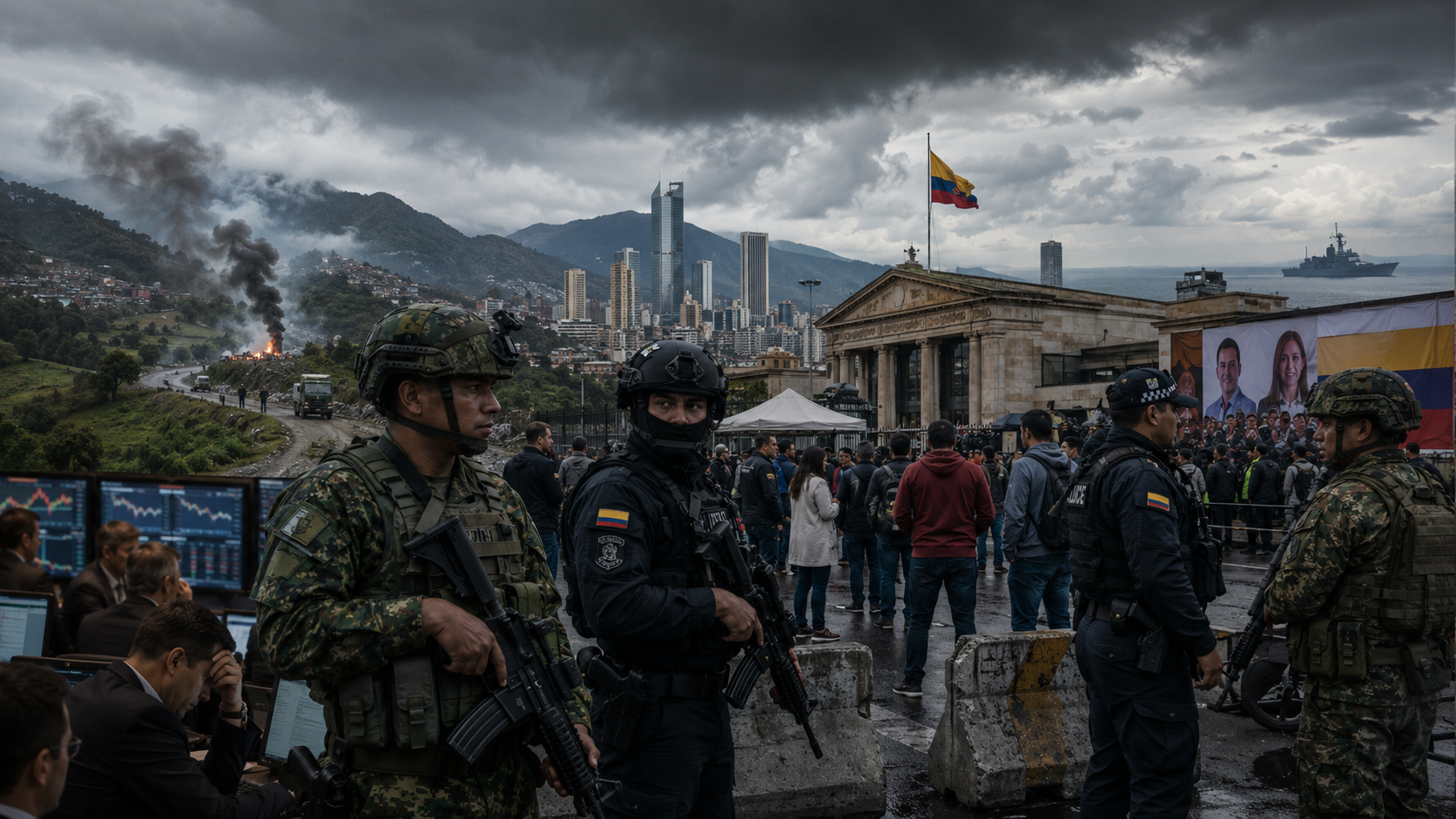
DECISION SIGNAL SYSTEM
COLOMBIA FLASHPOINT ASSESSMENT
Strategic Doctrinal Confusion, Total Peace Collapse, and a Left-Continuity Election Under Market Stress
Assessment Date: May 19, 2026
Analyst Frame: Composite Flashpoint Index (0-100); six-domain DSS read; Geoeconomic Monitoring System overlay
Composite Flashpoint Status: ORANGE — Borderline Red on Security and Doctrine; Yellow/Orange on Geoeconomics; Yellow on Election
Primary Question
Can the Colombian state simultaneously absorb a doctrinally fractured security architecture, the visible collapse of Paz Total, a fiscal and external pressure regime that has pushed Colombia above Brazil and Peru on country risk, and a left-continuity election with the right structurally fragmented, without the failure of one domain pulling the others into a synchronized crisis?
Executive Judgment
Colombia is in a structural security crisis. The crisis is not principally about crime or about any one armed group. The deeper failure is doctrinal. The Colombian state has, for two decades, blurred the institutional and constitutional boundaries between military defense, police-judicial functions, and strategic intelligence. The Petro administration has accelerated that blurring rather than resolved it. The country now operates with a militarized police, a police-oriented military, and a politicized strategic intelligence apparatus, at the same time that armed groups have grown approximately 85% in combatant strength (from roughly 6,500 in 2017 to about 25,000 today) and Total Peace has effectively failed as an integrated policy.
This doctrinal confusion is no longer an internal Colombian pathology. It is the same syndrome France and several other Western democracies now exhibit under the weight of hybrid threats, transnational organized crime, and cyber-enabled coercion. Colombia is a leading-edge laboratory for what happens when a 1991-vintage constitutional security architecture is forced to absorb 2026-vintage threat geometry without doctrinal renewal. The DSS implication is clear: Colombia must be tracked not only as a Latin American country case, but as an early-warning node for Western institutional-design stress.
Layered on top of this is a left-continuity election with no centrist coalition lever. The March 8, 2026, congressional vote produced a fragmented legislature in which Pacto Historico is the largest force in the Senate (25 of 103 seats), but no party holds a majority, and the Centro Democratico leads the House (32 of 183). Ivan Cepeda (Pacto Historico) leads first-round presidential polling at 44.3% in the most recent Invamer Colombia Opina survey, with Abelardo de la Espriella (Salvacion Nacional) at 21.5% and Paloma Valencia (Centro Democratico) at 19.8%. The combined right vote of 41.3% is mathematically insufficient to defeat Cepeda in the first round on May 31 if it cannot consolidate. The decision-relevant fact is not whether Cepeda wins, that is the base case, but whether he is forced into a runoff on June 21, and whether the runoff polarizes around constituent-assembly and security-doctrine issues rather than economic management.
The Geoeconomic Monitoring System overlay is now active. Colombia has overtaken Brazil and Peru on the country-risk indicator. The Colombian peso was the worst-performing emerging-market currency in the week ending May 8, 2026 (down 3.01%). The fiscal deficit ran 6.4% of GDP in 2025, with the Finance Ministry projecting 5.1% for 2026, a number most independent analysts view as optimistic. The current account deficit is projected to widen to 2.8% of GDP in 2026 and 3.0% in 2027. Damodaran's January 2026 dataset prices Colombia at a Baa3-equivalent country risk premium of 2.85% with an equity risk premium of 9.09%.
The U.S.-Colombia bilateral, historically a stabilizer, is now itself a risk vector. The September 2025 Trump administration decertification of Colombia on counter-narcotics (with a national-interest waiver preserving aid), combined with a U.S. naval posture in the Caribbean, has converted the security-cooperation relationship into a conditional, politically contested instrument.
Composite Flashpoint Posture: ORANGE. Three of the six DSS domains, Security and Doctrine, Geoeconomic Pressure, and U.S. Bilateral, are already at Orange or Borderline Red. Two (Political Legitimacy and Election Cycle) are Yellow. One (External Alignment and Multipolar Exposure) is Yellow/Borderline Orange. The compound-trigger rule is already partially activated by the security, geoeconomic, and U.S. bilateral cluster.
Flashpoint Thesis
Colombia's flashpoint is not a single event. It is the synchronized degradation of four interlocking systems: (1) a doctrinally confused security architecture that cannot cleanly assign warfighting, policing, judicial, and intelligence missions; (2) a Total Peace policy that has dispersed state coercive power across nine negotiation tables while armed groups consolidated territory and combatants; (3) a fiscal and external position that has lost relative standing among Latin American sovereigns; and (4) an election cycle that will produce continuity of a left government inside a fragmented Congress, with no centrist broker available to absorb shocks.
The dangerous pathway is not a coup, not a default, and not an insurgent military victory. It is a slow-motion convergence in which each domain's deterioration validates the others. A bad inflation print weakens fiscal credibility. Weak fiscal credibility forces security-budget cuts. Security-budget cuts hand more territory to armed groups. Armed-group consolidation forces the military deeper into police functions. Deepening military involvement in policing produces a human-rights incident. The incident weakens U.S. support. Weakened U.S. support raises country risk. Rising country risk weakens the peso. Peso weakness re-ignites inflation. Each turn of this loop ratifies the next.
The doctrinal failure is the load-bearing weakness. As long as Colombia treats every internal-security stress as a defense problem, the marginal cost of every new shock falls on an institution (the military) that was not designed, trained, equipped, or constitutionally authorized to absorb it. This is the same pathology now appearing in France's response to organized crime and transnational terrorism, and the same pattern visible in the militarization debates running through Western democracies after a decade of hybrid-threat evolution. Colombia is not a peripheral case. Colombia is the canary.
Current Signal State: Six-Domain DSS Read
| Domain | Current Signal | DSS Read | Decision Meaning |
|---|---|---|---|
| Security and Strategic Doctrine | Total Peace failed; armed groups up 85% since 2017; April 2026 coordinated attacks; doctrinal blur structural | Orange / Borderline Red | Treat as the load-bearing risk. Every other domain inherits stress from this one. |
| Political Legitimacy | Petro approval recovered pre-election, but capital was consumed on constituent-assembly rhetoric and court confrontations | Yellow / Borderline Orange | Petro’s lame-duck phase is not benign. He retains agenda-setting power and is using it on institutional questions. |
| Election Cycle | Fragmented Congress; Cepeda leads at 44.3%; right split between De la Espriella and Valencia; runoff highly probable | Yellow | The base case is left continuity under Cepeda. The tail case is a polarized runoff that becomes a referendum on the constituent assembly and security doctrine. |
| Geoeconomic Pressure | Country risk above Brazil and Peru; peso worst-performing EM currency week ending May 8; fiscal deficit 6.4% GDP 2025 | Orange | Move from EM bystander to EM stressed sovereign requires re-rating all Colombia exposure. |
| U.S. Bilateral and External Alignment | September 2025 decertification with national-interest waiver; U.S. naval posture in the Caribbean; aid now politically conditional | Orange | The historical U.S. security backstop can no longer be assumed. Condition all scenarios on this. |
| Counter-Narcotics and Illicit Economy | Cocaine production up 53% in 2023; UNODC relationship politicized; coca cultivation structurally high; one credible demobilization table only | Red | The cocaine economy is the financing layer underneath every other domain’s deterioration. |
The Doctrinal Flashpoint: Load-Bearing Analysis
The Core Doctrinal Claim
A modern state must, by design and through its constitutional architecture, distinguish among four structurally distinct missions.
National defense protects against external state and non-state adversaries. It operates through war-fighting doctrine, force projection, and deterrence. The lead institution is the armed forces. The legal frame is the laws of armed conflict and international humanitarian law.
Internal security and public order cover citizen safety, the maintenance of public order, and the response to organized crime, terrorism, and large-scale disorder. The lead institution is a civilian-controlled police. The legal frame is domestic criminal law and constitutional rights.
Judicial policing encompasses investigations in support of prosecutors, evidence handling, the chain of custody, and criminal procedure. The lead institution is a judicial police force under prosecutorial direction. The legal frame is the criminal procedure code.
Strategic intelligence provides decision-grade intelligence to the head of state and the national security council, with strict prohibitions on its domestic political use. The lead institution is a civilian strategic intelligence service. The legal frame is intelligence law with parliamentary oversight.
These four missions require different doctrines, training pipelines, force structures, legal regimes, and accountability architectures. They are not interchangeable. Interoperability does not equal interchangeability.
The Colombian Failure Mode
Colombia's 1991 constitution and subsequent reforms attempted to civilianize policing and civilianize strategic intelligence (replacing the DAS with the DNI in 2011). The reforms were doctrinally sound but operationally incomplete. In practice, the failure runs across three structural lines.
The National Police remains under the Ministry of Defense rather than a civilian Ministry of Citizen Security, and is structured, trained, equipped, and culturally oriented as a paramilitary force.
The Military Forces routinely perform internal security and quasi-judicial police functions, particularly in rural Colombia, where the civilian state has limited presence.
The DNI, doctrinally civilian, sits directly under the presidency without the parliamentary oversight architecture of mature Western intelligence services. Persistent gaps in legislative oversight remain documented.
The Constitutional Court has become, in practice, a fourth political power. Its expansive role partially compensates for institutional weakness elsewhere but also distorts the legality-legitimacy balance.
The Petro government's human-security doctrine was an attempt to reorient the architecture without re-engineering it. The result has been doctrinal incoherence at the operational level. The same soldiers are simultaneously told to de-escalate, to negotiate, to protect civilians, to act as judicial police, and to fight armed groups whose ceasefires can collapse without notice.
Why This Matters for the DSS
Doctrinal confusion is not a soft variable. It produces measurable degradation across six symptom categories.
| Symptom | Mechanism | DSS Indicator |
|---|---|---|
| Operational casualties among soldiers and police | Forces operating outside their doctrinal mission take higher casualties per engagement | Monthly KIA, WIA, MIA for army, marines, police, broken out by mission type |
| Human-rights incidents | Soldiers performing police functions produce civilian casualties that police would not, and vice versa | Defensoria del Pueblo, OHCHR, and CIDH complaints; judicial proceedings against uniformed personnel |
| Cost inflation | Using a high-cost military asset to perform a lower-cost police function produces structural over-expenditure | Defense budget as % of GDP vs. equivalent-mission cost benchmarks |
| Accountability dilution | Overlapping authorities make it impossible to assign responsibility for failures | Number of inter-institutional jurisdictional disputes per year |
| Intelligence politicization | Strategic intelligence used for domestic political purposes degrades its ability to produce decision-grade external warning | Frequency of DNI, Fiscalia, and Defensoria conflicts; opposition complaints of surveillance |
| Force generation collapse | Recruitment and retention degrade as the institutional value proposition becomes incoherent | Army, Marines, and Police recruiting numbers; NCO retention rates; officer attrition |
The Doctrinal Stress Register
This sub-module plugs into the GMS as a dedicated Colombia indicator tab. It is portable to France, Mexico, Brazil, and the U.S. domestic deployment debate.
| Axis | Indicator | Green | Yellow | Orange | Red |
|---|---|---|---|---|---|
| Mission-to-doctrine fit | % of military operations classified as internal-security or police functions | <20% | 20-35% | 35-50% | >50% |
| Police militarization | % of National Police budget on warfighting-grade equipment and training | <15% | 15-25% | 25-40% | >40% |
| Intelligence politicization | Credible domestic-political-use complaints against DNI or military intel per quarter | 0-1 | 2-4 | 5-8 | >8 |
| Jurisdictional disputes | Formal inter-institutional jurisdictional conflicts per quarter | <3 | 3-6 | 7-12 | >12 |
| Casualty doctrine mismatch | KIA in operations outside primary doctrinal mission as % of total KIA | <10% | 10-20% | 20-35% | >35% |
| Civilian-casualty and IHL exposure | Confirmed civilian-casualty events attributable to security forces per quarter | 0-2 | 3-5 | 6-10 | >10 |
Current Colombia read: Yellow on axes 2 and 3. Orange on axes 1, 4, and 6. Red-adjacent on axis 5. Composite doctrinal stress score: ORANGE.
The Western Convergence Point
The observation that France and other Western democracies are now experiencing the same doctrinal tensions is analytically correct and DSS-relevant. France's deployment of the army in Sentinelle, Italy's Strade Sicure, Spain's Operacion Centinela Gallego, the U.K.'s military aid to civil power frameworks, U.S. National Guard deployments for domestic security, and Germany's debates over Bundeswehr internal deployments all instantiate the same problem: how does a 20th-century constitutional architecture absorb 21st-century hybrid threats without doctrinally collapsing the distinction between defense and policing?
Colombia, because it has confronted this problem continuously for forty years, is a leading indicator, not a lagging one. The DSS should treat Colombian doctrinal-stress signals as forward-pointing readings for Western institutional design risk over the 2026-2030 horizon.
The Instability Spiral: Colombia Six-Loop Model
The loop runs without requiring any catalytic event. The analysis of Argentina treated reflexivity as an electoral market. The Colombia loop is a form of doctrinal-fiscal reflexivity that is structurally more dangerous because it is slow, distributed across multiple institutions, and harder to interrupt with a single policy decision.
The loop sequence: (1) Doctrinal blur forces the military into police roles. (2) Armed groups consolidate under a fragmented state response. (3) A civilian casualty event occurs. (4) External bilateral and IHL pressure follows. (5) Security-budget compression results. (6) Fiscal and external repricing feeds back to Stage 1.
| Stage | Mechanism | Leading Indicators | Escalation Consequence |
|---|---|---|---|
| 1. Doctrinal blur | Soldiers performing police functions; police operating under warfighting rules; DNI tasked for domestic political analysis | Reassignment orders, joint operations counts, DNI tasking patterns, and public complaints from military commanders | Operational overstretch; higher KIA per engagement |
| 2. Armed-group consolidation | ELN, FARC dissidents, Clan del Golfo expand under Total Peace ceasefires | Combatant count; territorial control maps; displacement counts; armed-strike days | Loss of state presence in 40+ municipalities |
| 3. Civilian casualty event | Indiscriminate fire, false positives, mass-casualty bombing | INDEPAZ, Red por la Vida, Defensoria reports; ACLED event counts | Triggers JEP, Fiscalia, and OHCHR proceedings |
| 4. External bilateral and IHL pressure | Decertification; conditioning of U.S. military aid; ICC referrals; EU human-rights resolutions | INCSR designations; State Department human rights reports; ICC and IACHR statements | Cooperation freezes; training cancellations; equipment delays |
| 5. Security-budget compression | Loss of U.S. funding plus fiscal pressure forces nominal or real defense-budget cuts | MinHacienda budget proposals; MinDefensa execution rates | Reduced force generation; lower operational tempo |
| 6. Fiscal and external repricing | Country risk reprices; peso weakens; financing window narrows | EMBI spread; COP/USD rate; 10-year peso bond yield; CDS; IMF Article IV cadence | Inflation pass-through; current-account stress; growth downgrades |
Geoeconomic Monitoring System Overlay
The GMS six-domain architecture is fully active for Colombia as a standalone module with cross-links to the South China Sea critical-minerals indicator, the Mali/Sahel resource-conflict indicator, and the Argentina election-market indicator.
Domain Mapping
| GMS Domain | Colombia-Specific Reading | Status |
|---|---|---|
| Capital flows and sovereign risk | EMBI+ Colombia component above Brazil and Peru; peso -3.01% week ending May 8, 2026; Damodaran country risk premium 2.85%; bond sales omitted from 2026 financing plan | Orange |
| Trade and commodity exposure | Oil (Ecopetrol primary), coal (constrained by Petro anti-extractivist stance), agricultural exports under FX and weather stress; coal export outlook mixed pending election; Ecopetrol 2026 capex COP 22-27 trillion | Yellow / Orange |
| Energy and critical minerals | No new hydrocarbon exploration contracts under Petro; reserve depletion accelerating; coal phaseout policy in tension with fiscal needs; lithium, copper, and nickel underdeveloped | Orange |
| Fiscal and monetary | Fiscal deficit 6.4% (2025), projected 5.1% (2026); independents project closer to 6%; tax-reform failure; current account widening; gross debt rising | Orange |
| Security and institutional integrity | Doctrinal confusion; Total Peace failed; armed-group expansion; intelligence reform incomplete; Constitutional Court tensions | Red |
| External alignment and sanctions exposure | U.S. decertification with waiver; ELN naming U.S. as a sovereignty threat; ICC engagement; China engagement growing (Belt and Road MOU 2025); Venezuela border instability | Orange |
Composite Status Rule
| Status | Conditions | DSS Action |
|---|---|---|
| Green / Monitor | EMBI <450 bps; peso stable +/-2% over 90 days; fiscal deficit <4%; no major armed-group escalation; U.S. cooperation normalized | Monthly cadence |
| Yellow / Activate contingency | EMBI 450-550 bps; peso volatility 2-4% over 30 days; fiscal 4-5%; one armed-group flare-up; U.S. cooperation conditional | Weekly cadence; scenario refresh |
| Orange / Activate executive contingency (CURRENT) | EMBI 550-750 bps; peso -3% to -5% over 30 days; fiscal >5%; two or more concurrent armed-group flare-ups; U.S. decertification active | Bi-weekly leadership briefings; pre-position exposure decisions; stress-test counterparties |
| Red / Execute | EMBI >750 bps; peso -5% or more over 30 days; fiscal >6.5% with no credible adjustment; mass-casualty event with constitutional escalation; U.S. bilateral rupture or sanctions designation | Execute pre-committed actions |
Total Peace Status Board
Total Peace overall posture: Failed at the national-strategic level. Functional only at the Comuneros del Sur sub-regional level. The DSS formally retires the assumption that Total Peace constitutes a security policy. Treat it instead as a disaggregated set of micro-negotiations operating against a backdrop of net armed-group expansion.
| Table | Counterparty | Current Status | DSS Trigger |
|---|---|---|---|
| ELN national table | ELN central command | Suspended after the January 2025 Catatumbo offensive. 52,000 displaced. Approximately 80 killed. Intermittent unilateral ceasefires without operational substance. | Red trigger if ELN launches a synchronized national armed strike during the election window |
| Comuneros del Sur | ELN dissident faction, Narino | Active and progressing. Bilateral ceasefire, disarmament protocols, 5,000 hectares of coca substitution (April 2025). | Watch as the only credible demobilization template. Protect from contagion failure. |
| Estado Mayor Central | FARC dissident bloc led by Ivan Mordisco | Fragmented. Partial demobilization talks with one sub-bloc. Mordisco faction actively waging Cauca offensive (April 2026). | Red trigger if EMC consolidates with Segunda Marquetalia under unified command |
| Segunda Marquetalia | FARC dissident bloc, Ivan Marquez line | Sporadic engagement. Primary presence in the Pacific corridor and the Venezuela border. | Orange trigger if the Venezuelan sanctuary becomes operational as a rear area |
| Clan del Golfo / AGC | Largest criminal and paramilitary structure | Sujetamiento a la justicia framework with no political-status concession. Talks intermittent. | Red trigger if Clan del Golfo links with EMC under cocaine-corridor consolidation |
| Urban gangs | Various in Medellin, Buenaventura, and Quibdo | Mixed. Some local truces; frequent collapses. | Local DSS read. Not a national escalator unless port operations are affected. |
| Sinaloa-linked structures | Mexican-linked traffickers | Not a peace table. Designation and sanctions vector. | Watch for OFAC designations of Colombian nodes |
Election Cycle: DSS Read
Election DSS posture: Yellow. The election itself is not the flashpoint. The transition is. The dangerous window runs from June 7 (first-round results) through August 7, 2026 (inauguration), when the lame-duck Petro government holds full executive authority alongside a new Congress and a likely Cepeda president-elect. That window is when constituent-assembly maneuvers, last-minute appointments, decree-law issuance, and intelligence-architecture changes can occur.
| Variable | Reading | Decision Implication |
|---|---|---|
| First-round leader | Ivan Cepeda (Pacto Historico) at 44.3% in the Invamer poll 21; leads every major survey | Left continuity is the base case. Markets are increasingly pricing this. |
| First-round threshold | 50%+1 required to avoid runoff. Cepeda above 40% in only one poll. | Runoff on June 21 is the high-probability path. |
| Right consolidation | De la Espriella (21.5%) plus Valencia (19.8%) equals 41.3%, below Cepeda’s 44.3%; no vote-transfer math reaches 50%+1 | The right cannot win the first round even with full consolidation. Runoff is the only viable path. |
| Centrist collapse | Centrists below 5% relevance; Oviedo joined Valencia as VP candidate | No coalition broker available. The election will polarize. |
| Congressional balance | Pacto Historico largest Senate force (25 of 103); Centro Democratico largest House force (32 of 183); no party above 25% | The next president faces an ungovernable Congress without a coalition. Reform throughput will be low. |
| Election violence | MOE flagged extreme risk in 11% of municipalities; armed-group veto power in 69 municipalities; Senator Quilcue kidnapped and released; Castellanos’ caravan attacked | Treat election security as a domain-specific Orange. |
| Constituent assembly threat | Petro stated intent to put the constituent assembly to a vote; Cepeda is more institutionally cautious but inherits the rhetorical apparatus | Orange trigger if assembly proposal enters the serious legislative process post-election |
Geostrategic Flashpoints: Colombia-Anchored
| Flashpoint | Status | Election-Window Relevance | DSS Trigger |
|---|---|---|---|
| Venezuela border and Catatumbo | Orange | A second Catatumbo-scale offensive during the election window would force a state-of-emergency or militarization decision under a transitional government | Red trigger if displaced population exceeds 30,000 in any 30-day window or if Colombian forces operate inside Venezuelan territory |
| U.S. Caribbean posture | Orange | Petro and Cepeda likely to invoke sovereignty narrative; risks tying U.S. counter-narcotics cooperation to election politics | Orange trigger if U.S. operational activity expands beyond a stand-off posture |
| Pacific cocaine corridor | Red | Cocaine flows underwrite armed-group financing throughout the election cycle | Red trigger if Pacific port operations are forcibly interrupted |
| Andean copper-lithium frontier | Yellow | Watch as a 2027-2030 indicator, not 2026; mining policy under Petro hostile; election outcome affects future pipeline | Orange trigger if a Cepeda administration formalizes a moratorium |
| Constitutional and institutional rupture | Orange | Lame-duck window is the highest risk for executive-decree institutional moves | Red trigger if executive issues decrees attempting to alter intelligence, judicial, or military command architecture without congressional authorization |
| U.S. decertification escalation | Orange | September 2025 decertification with national-interest waiver; INCSR 2026 report cadence is the pressure point | Red trigger if the national-interest waiver is removed or if specific designation actions target Colombian officials |
DSS Indicator Library: Colombia v1.0
Security and Doctrine Indicators
| Indicator | Green | Yellow | Orange | Red | Source Cadence |
|---|---|---|---|---|---|
| Armed-group combatant count (est.) | <15,000 | 15-22,000 | 22-28,000 | >28,000 | INDEPAZ, Defensoria, ACLED — quarterly |
| Forced displacement (30-day) | <5,000 | 5-15,000 | 15-30,000 | >30,000 | UNHCR, Defensoria — weekly |
| Self-confinement (90-day) | <10,000 | 10-25,000 | 25-50,000 | >50,000 | UNHCR, Defensoria — monthly |
| Homicide rate (per 100k, rolling 12m) | <22 | 22-26 | 26-30 | >30 | DANE, Policia Nacional — monthly |
| Mass-casualty events per quarter | 0 | 1 | 2 | 3+ | ACLED, INDEPAZ — quarterly |
| Soldiers and police KIA per month | <10 | 10-25 | 25-50 | >50 | MinDefensa — monthly |
| Defensoria early-warnings issued per month | <5 | 5-10 | 10-20 | >20 | Defensoria — monthly |
| Election-violence events per month | <10 | 10-25 | 25-50 | >50 (election window) | MOE, INDEPAZ — weekly during cycle |
Geoeconomic Indicators
| Indicator | Green | Yellow | Orange | Red | Source |
|---|---|---|---|---|---|
| EMBI+ Colombia spread | <450 bps | 450-550 bps | 550-750 bps | >750 bps | JPM — daily |
| COP/USD (30-day change) | +/-2% | 2-4% | 4-6% | >6% | BanRep — daily |
| 10-year peso TES yield | <10% | 10-12% | 12-14% | >14% | BanRep — daily |
| 5-year USD CDS Colombia | <200 bps | 200-300 bps | 300-450 bps | >450 bps | Markit — daily |
| Fiscal deficit (% GDP) | <4% | 4-5% | 5-6.5% | >6.5% | MinHacienda — quarterly |
| Current account deficit (% GDP) | <2% | 2-3% | 3-4% | >4% | BanRep — quarterly |
| DIAN tax revenue (% vs plan) | >100% | 95-100% | 90-95% | <90% | DIAN — monthly |
| International reserves | Stable / rising | Flat | Drawing | Sustained drawdown | BanRep — weekly |
| Ecopetrol production (kbd) | >700 | 650-700 | 600-650 | <600 | Ecopetrol — quarterly |
| Coal export volume vs plan | At or above plan | -5% | -10% | -20% | Cerrejon, Drummond, MinMinas — monthly |
Political and Institutional Indicators
| Indicator | Green | Yellow | Orange | Red |
|---|---|---|---|---|
| Petro approval (lame-duck) | >40% | 30-40% | 20-30% | <20% |
| Cepeda’s first-round vote intention | >50% | 40-50% | 30-40% | <30% (right consolidates) |
| Runoff probability | <30% | 30-60% | 60-80% | >80% (current) |
| Constituent-assembly proposal status | Off agenda | Rhetorical | Legislative drafting | Floor vote scheduled |
| Constitutional Court vs. Executive disputes per quarter | <2 | 2-4 | 5-8 | >8 |
| JEP, Fiscalia, and Procuraduria conflicts | Routine | Elevated | Open public confrontation | Institutional rupture |
| Major-city mayor opposition coalition | Fragmented | Coordinated rhetoric | Formal coalition | Joint legal action vs. the national government |
External and Counter-Narcotics Indicators
| Indicator | Green | Yellow | Orange | Red |
|---|---|---|---|---|
| U.S. certification status | Certified | Conditional | Decertified + waiver (current) | Decertified, no waiver |
| U.S. military aid (% of plan) | 100% | 90-100% | 75-90% | <75% |
| EU / Schengen human-rights resolutions | None | One advisory | Multiple advisories | Sanctions discussion |
| ICC and IACHR activity | Routine monitoring | Preliminary examination | Formal investigation | Indictment or measures |
| Coca cultivation (hectares) | <150,000 | 150-200,000 | 200-230,000 | >230,000 |
| Cocaine production (mt potential) | <1,500 | 1,500-2,000 | 2,000-2,500 | >2,500 (UNODC dispute zone) |
| Maritime interdiction (mt seized) | >700 | 500-700 | 300-500 | <300 |
Compound Triggers
| Rule | Conditions and Active Triggers |
|---|---|
| Two-of-three escalation rule (Yellow to Orange) — ALREADY TRIGGERED | Security trigger: April 2026 FARC-dissident wave (Cajibio bombing, Cali base car bomb, 26+ attacks since April 25). Geoeconomic trigger: peso -3.01% in the week ending May 8; country risk above Brazil and Peru. External trigger: U.S. decertification with waiver; ELN sovereignty narrative; U.S. Caribbean posture. |
| Three-of-six escalation rule (Orange to Red) | Mass-casualty event with more than 50 dead in a single incident, OR sustained displacement above 30,000 in 30 days. EMBI rises above 750 bps OR peso depreciates more than 6% in 30 days. U.S. national-interest waiver is withdrawn, or U.S. officials sanction Colombian individuals. Lame-duck executive decree alters military, police, or intelligence command architecture without congressional consent. Runoff produces a contested result with a credible challenge. Constituent-assembly proposal advances to legislative drafting under a lame-duck or transitional government. |
| Doctrinal-stress trigger | Move one composite level higher if any two doctrinal stress axes hit Red simultaneously. This is the institutional-design escalator. |
| Election-window trigger | Tighten cadence to daily between May 24 (one week before the first round) and August 7 (inauguration). The lame-duck window is the highest-conviction tail-risk window of 2026. |
Scenario Analysis
| Scenario | Prob. | Description | DSS Posture |
|---|---|---|---|
| A — Managed continuity | 35% | Cepeda wins the runoff with a clear margin. Accepts an institutionally moderate posture in transition. Retains continuity with the Constitutional Court and JEP. Quietly drops constituent-assembly rhetoric. Launches a serious doctrinal reform commission. Markets reprice for left continuity but not regime risk. Fiscal adjustment slow but credible. | Yellow / Orange. Active monitoring. No execution. |
| B — Polarized continuity (base case) | 30% | Cepeda wins the runoff narrowly. Lame-duck Petro window used for executive-decree institutional moves on intelligence and judicial-political architecture. Congress is ungovernable; reforms are blocked. Armed-group expansion continues; one or two more mass-casualty events in 2026 second half. Country risk widens. Peso stays under pressure. U.S. relationship remains decertified with a waiver. | Orange. Activate executive contingency. Weekly cadence. |
| C — Doctrinal rupture | 15% | A mass-casualty event during the election window converges with a major financial reprice. Constituent-assembly rhetoric escalates. Congress and the executive clash over intelligence architecture changes. U.S. waiver withdrawn. | Red. Execute pre-committed actions. |
| D — Right consolidation surprise | 10% | De la Espriella consolidates the right before the first round. Forces a runoff against Cepeda. Wins narrowly. Markets rally on a security-first frame but immediately face a left-leaning Senate, an institutionalist Constitutional Court, JEP continuity, and an emboldened armed-group response. Security situation worsens before it improves. | Yellow / Orange. Re-base scenarios on right-government feasibility. |
| E — External shock dominant | 10% | A Venezuela escalation overwhelms Colombian election dynamics. Catatumbo becomes a forward operating environment. ELN posture hardens. Petro and Cepeda invoke the sovereignty narrative. | Red. Treat it as a compound regional flashpoint. Re-anchor analysis to the Caribbean basin. |
Decision Guidance
For Executive Leadership
Treat Colombia as a doctrinal early-warning case, not a peripheral Latin American watch. The portable insight is the doctrinal-stress register: any Western client with internal-deployment exposure (France, Italy, Spain, the U.K., the U.S. domestically, Germany) should read Colombia's monthly readings as a leading indicator of their own institutional-design risk over 2026-2030. Update the executive briefing cadence from monthly to bi-weekly through Q3 2026.
For Investors and Finance Teams
Three specific moves are required.
- De-couple Colombia from generic Andean exposure. Colombia has crossed Brazil and Peru on country risk and should no longer be modeled in the same bucket.
- Watch the bond-curve election premium. Apply the Argentina post-2027 premium method to Colombian sovereign bonds maturing after August 7, 2026, and compare with those maturing before. A widening premium is the cleanest market-implied signal of transition risk.
- Stress-test for fiscal compression. Model the Cepeda baseline at a 6.0% fiscal deficit for 2026 (above the Finance Ministry's guidance of 5.1%) and 5.5-6.0% for 2027, with the current account at 3.0% of GDP.
For Enterprise and Portfolio Managers
Classify Colombia exposure by doctrinal sensitivity, not just by sector.
- High doctrinal sensitivity: infrastructure, extractives, telecom, logistics, security services, and defense contractors — anything that interfaces with the state coercive apparatus. Stress-test against Scenario C (doctrinal rupture). Long-cycle commitments require explicit transitional government exit ramps.
- Medium sensitivity: financial services, consumer goods with rural distribution, and agribusiness in conflict zones.
- Low sensitivity: Bogota-centered services, technology, and urban consumer.
For Risk and Communications Teams
Prepare three communications tracks.
- Continuity with stress (Scenarios A and B): emphasize institutional resilience and Cepeda's institutionalist posture.
- Doctrinal rupture (Scenario C): emphasize the distinction between policy continuity and institutional continuity.
- External shock (Scenario E): emphasize regional Caribbean-basin framing, not bilateral Colombia framing.
Priority Watchlist: Next 90 Days
| Watch Item | Why It Matters | Next DSS Action |
|---|---|---|
| May 31 first-round result | Determines whether a runoff occurs and which right candidate advances | Daily cadence May 24 through June 7 |
| June 21 runoff result | Determines the transition pathway | Daily cadence June 14 through June 28 |
| Lame-duck executive decrees (June 22 through August 6) | Highest institutional-rupture risk window of the year | Twice-daily cadence with named-decree watchlist |
| Catatumbo and Cauca security flare | A second January-2025-scale event during the election would force a doctrinal decision under a transitional government | Weekly Defensoria and INDEPAZ review |
| Peso, EMBI, and 10-year TES yield | Three-instrument financial transmission monitor | Daily during the election window |
| U.S. national-interest waiver review | Withdrawal is a hard Red trigger | Track State Department and INCSR cadence |
| Constituent-assembly legislative status | Movement from rhetoric to drafting is an Orange escalator | Weekly congressional tracker |
| Constitutional Court rulings on executive decrees | The Court is the load-bearing institutional firewall | Per-ruling read; flag any 4-5 split rulings on security or intelligence matters |
| ELN, EMC, and Clan del Golfo joint signaling | Cross-group coordination is the highest-risk security escalator | Weekly INDEPAZ and ACLED scan |
| U.S. Caribbean naval posture | Conversion from posture to operations is a hard trigger | Weekly DoD and SOUTHCOM open-source monitor |
| Damodaran 2026 mid-year country risk update | Calibrates the equity-risk-premium overlay | Refresh on publication |
Cross-References to Ridgeline and Inngility DSS Modules
- Argentina Election Flashpoint (May 17, 2026): share the political-market reflexivity template; Colombia adds doctrinal reflexivity as a second loop.
- Mali Flashpoint (May 2026): share the Total Peace-style negotiations-as-policy failure mode; Colombia is the more institutionally developed analogue.
- Baltic Deep Dive (March 30, 2026): share the hybrid-threat and doctrinal-stress framing for Western democracies.
- BTS v3.1 Pressure Test: Colombia slots as a country-level stress vector.
- Inngility Indicator Library Q2 2026: the doctrinal-stress register adds six new portable indicators.
- 2026 ATA Policy Analysis, Signal Layer: Colombia confirms the ATA's signaled concerns on transnational organized crime, doctrinal blur, and Western institutional-design pressure.
Bottom Line
Colombia is not heading into a single crisis. It is operating inside a structural crisis already in motion, doctrinal, geoeconomic, electoral, and external, in which no single domain has yet fallen to Red, but three are already at Orange, and the compound trigger is partially activated.
The central failure is doctrinal, not criminal. Internal security is not equivalent to national defense. Interoperability is not interchangeability. A 1991-vintage architecture absorbing 2026-vintage threats without doctrinal renewal produces a militarized police, a police-oriented military, and a politicized intelligence service. Colombia is the most advanced laboratory in the Western Hemisphere in terms of what it produces over time.
DSS posture: ORANGE — Borderline Red on Security and Doctrine through August 7, 2026 (presidential inauguration). De-escalation requires: (a) a clean election with a runoff resolved by July 1; (b) no lame-duck executive-decree institutional moves; (c) no second Catatumbo-scale displacement event; (d) peso stabilization within +/-3% of current levels; and (e) the U.S. national-interest waiver remaining intact. Escalation to Red requires any three of the compound-trigger conditions in any 45-day window.
The portable strategic point, and the one to elevate in client briefings, is this: Colombia is the canary. France, Italy, Spain, the U.K., the U.S., and Germany are at earlier stages of the same doctrinal pressure. The Colombian doctrinal stress register should be ported into each of those country modules as a benchmark and an early-warning instrument.